Introduction to Manglik Dosha
Marriage compatibility in Vedic astrology involves more than matching the 36 Gunas or comparing the Moon signs of two individuals. One important factor examined during marriage-related Kundli analysis is Manglik Dosha, which forms through the placement of Mars (Mangal) in particular houses of the birth chart.
Mars represents courage, physical energy, passion, determination, aggression and the ability to take action. Its placement receives special attention during marriage analysis because certain houses connected with personality, family, domestic happiness, spouse and marital responsibilities are traditionally considered sensitive to its influence.
Manglik Dosha is traditionally associated with possible challenges in married life, including differences in temperament, disagreements, impatience and difficulties in adjusting to a partner. However, the presence of Manglik Dosha does not automatically indicate an unhappy marriage, separation or divorce. The actual interpretation depends on Mars’s house placement, zodiac sign, functional lordship, planetary strength, conjunctions, aspects and relationship with the seventh house of marriage.
A complete Manglik Dosha assessment also examines Mars from the Ascendant (Lagna), Moon and Venus. Different Jyotish traditions follow different rules about which houses are considered, which reference points are used, and which conditions can cancel or reduce the effect of the Dosha. To understand these differences, along with the classifications of Anshik Manglik Dosha and Purna Manglik Dosha, helps provide a more accurate understanding of this important marriage-related combination.
What Is Manglik Dosha in Vedic Astrology?
Manglik Dosha Meaning | What Does Manglik Mean?
Manglik Dosha means a traditional Vedic astrology condition associated with the placement of Mars in specific houses of the birth chart. Under the five-house calculation convention, Mars in the 1st, 4th, 7th, 8th or 12th house creates a Manglik indication. However, the six-house convention also includes the 2nd house, which represents family, speech and accumulated wealth. Thus, the two conventions differ in whether Mars’s placement in the 2nd house is considered a Manglik indication.
Mars is known as Mangal, Kuja and Bhauma in Sanskrit. Therefore, Manglik Dosha is also called Mangal Dosha, Kuja Dosha or Bhauma Dosha. The term ‘Chevvai Dosham’ is also commonly used for this condition in South India.
A person is traditionally considered Manglik when Mars occupies the 1st, 2nd, 4th, 7th, 8th or 12th house of the birth chart. This rule applies equally to male and female horoscopes. For example, a man with Mars in the 7th house and a woman with Mars in the 8th house both receive a Manglik indication under the six-house calculation. The same planetary placement rules apply regardless of whether the person is unmarried or already married.
However, identifying Manglik Dosha and interpreting its influence are two different stages of horoscope analysis. Mars occupying a particular house creates a preliminary indication under the selected calculation method. Its zodiac sign, house lordship, dignity, conjunctions, aspects and relationship with other marriage-related factors determine the overall interpretation.
Manglik Dosha is a recognised concept within traditional Vedic astrology. However, its claimed influence on marital outcomes has not been scientifically established. Its traditional interpretation should not be confused with scientific proof that a particular planetary placement causes marital problems.
Why Is Mars Associated With Manglik Dosha?
Mars is considered a natural malefic Graha in Vedic astrology and represents Agni Tattva, courage, physical strength, determination, competition, passion and assertiveness.
A strong and well-supported Mars can indicate leadership, confidence, initiative, discipline and the courage to face difficult situations. It gives a person the ability to take action and stand firmly by decisions.
However, when Mars is afflicted or poorly supported, its fiery nature is traditionally associated with impatience, aggression, dominance, impulsive reactions and confrontational behaviour. These aspects receive particular attention when Mars occupies houses connected with marriage, family and domestic happiness.
The 2nd house represents family and speech, the 4th house represents domestic happiness, the 7th house represents marriage and partnerships, the 8th house represents shared marital responsibilities, and the 12th house represents private life and intimacy. The 1st house represents the individual’s personality and temperament.
Therefore, Mars in these houses is examined to understand how its energy may influence personal behaviour, family adjustment and married life.
However, Mars being a natural malefic does not mean every placement produces negative results. Its functional lordship, planetary dignity and relationship with other Grahas must also be considered.
Which Houses Are Considered for Manglik Dosha?
Different Jyotish traditions follow different house-placement rules for identifying Manglik Dosha. It is important to understand these variations before checking whether a person is Manglik.
Three formulations are particularly useful to distinguish:
|
Calculation method
|
Houses considered
|
|
Common five-house convention
|
1st, 4th, 7th, 8th and 12th
|
|
Six-house convention
|
1st, 2nd, 4th, 7th, 8th and 12th
|
|
The five-house formulation was discussed by B. V. Raman in Muhurtha.
|
2nd, 4th, 7th, 8th and 12th
|
The difference is important. As per B. V. Raman Muhurtha, a Kerala Shastra formulation that includes the 2nd house but excludes the 1st house. This is not simply the six-house method with one house removed from the same list. In his discussion, he also examines Mars from Lagna, Moon and Venus and describes different levels of importance for these reference points. His formulation is one documented approach, not a universal rule followed by every Jyotish tradition.
A reliable Manglik Dosha check should therefore identify the calculation method being used rather than presenting one house list as universally accepted.
The following table explains why the six commonly discussed houses receive attention in marriage-related astrology.
|
House
|
Sanskrit name
|
Main area represented
|
|
1st
|
Tanu Bhava / Lagna Bhava
|
Personality, body and temperament
|
|
2nd
|
Dhana Bhava / Kutumba Bhava
|
Family, speech and accumulated wealth
|
|
4th
|
Sukha Bhava
|
Home, mother and domestic happiness
|
|
7th
|
Yuvati Bhava / Kalatra Bhava
|
Marriage and partnerships
|
|
8th
|
Randhra Bhava / Ayu Bhava
|
Longevity, shared resources and sudden changes
|
|
12th
|
Vyaya Bhava
|
Expenditure, private life and bed comforts
|
-
Manglik Dosha in the First House
The first house, known as Tanu Bhava or Lagna Bhava, represents the physical body, personality, temperament, confidence and overall approach towards life.
Mars in the first house can make a person energetic, courageous, independent and determined. It gives an assertive personality and the ability to take the lead in different situations.
However, when Mars is afflicted, its fiery nature may manifest through impatience, impulsive reactions, dominance and difficulty accepting opposing opinions.
One important reason Mars in the first house receives attention during Manglik Dosha analysis is its seventh aspect, which directly influences the seventh house of marriage.
The seventh house represents partnerships, spouses and married life. Therefore, Mars’s influence on this house is examined to understand whether the person’s assertive nature may create disagreements, competitiveness or difficulties in adjusting to a partner.
The seventh lord, Venus, and Navamsa must also be examined before drawing conclusions. A favourable relationship between Mars and other marriage-related planets may modify how this placement is interpreted.
-
Manglik Dosha in the Second House
The second house, known as Dhana Bhava or Kutumba Bhava, represents accumulated wealth, family values, speech, food habits and family relationships. It also indicates the family environment established after marriage.
Mars in the second house can make communication direct, confident and forceful. A well-supported Mars may indicate determination in managing family responsibilities and financial matters.
However, when afflicted, its placement may be associated with harsh speech, arguments concerning family responsibilities, financial disagreements or difficulty adjusting to household expectations.
Mars’s seventh aspect from the second house falls on the eighth house. This connects family matters with joint finances, inheritance and shared responsibilities within marriage.
This is one reason certain Jyotish traditions include the second house in Manglik Dosha calculation. Its interpretation focuses particularly on communication, family adjustment and financial responsibilities after marriage.
-
Manglik Dosha in the Fourth House
The fourth house, known as Sukha Bhava, represents the mother, home, property, emotional security, domestic happiness and inner peace.
Mars in this house brings an active and assertive influence into domestic matters. It may indicate a strong desire to manage household decisions independently, take responsibility for property matters or establish greater control over the home environment.
Mars’s special fourth aspect also falls directly on the seventh house when it occupies the fourth house. This is an important reason why this position receives attention during marriage analysis.
When Mars is afflicted, traditional interpretations may associate this placement with disagreements over household responsibilities, difficulty adjusting to family circumstances or disturbance in emotional peace.
The fourth lord and moon must also be examined. The fourth lord provides information about the strength of domestic happiness, while the Moon represents the emotional state and mental comfort. Their relationship with the seventh house helps provide a broader interpretation of married life.
-
Manglik Dosha in the Seventh House
The seventh house, known as Yuvati Bhava or Kalatra Bhava, is the principal house of marriage, spouse, committed relationships and partnerships.
Mars placed directly in this house receives particular attention because it occupies the house, representing married life.
Its fiery and assertive nature may indicate strong passion, attraction, competitiveness and a desire to take the lead in relationships. A well-supported Mars can also represent confidence and the ability to take responsibility within a partnership.
However, when Mars is afflicted, traditional interpretations may associate this placement with ego clashes, impatience, arguments, competitiveness and difficulty compromising with a partner.
Mars also casts its seventh aspect on the first house from this position, creating a connection between the native’s personality and the seventh house of marriage.
Before interpreting this placement, the seventh lord, Venus, Jupiter, planetary conjunctions and Navamsa must be examined. The dignity of the seventh lord and its placement and relationship with benefic or malefic planets provide important information about marital prospects.
Mars in the seventh house does not automatically indicate an unhappy marriage, separation or divorce. Its overall influence depends on the complete horoscope.
-
Manglik Dosha in the Eighth House
The eighth house, known as Randhra Bhava or Ayu Bhava, represents longevity, inheritance, joint finances, sudden changes, in-laws and shared responsibilities.
In marriage-related astrology, this house receives particular attention because it represents the deeper bond between partners and the responsibilities that develop after marriage.
Mars in the eighth house may indicate an intense approach towards shared resources, family matters and financial responsibilities. When afflicted, its placement may be associated with disagreements concerning joint investments, inheritance, financial transparency or adjustments with in-laws.
Mars’s seventh aspect from the eighth house falls on the second house. This creates an astrological connection between joint marital responsibilities and family finances.
The eighth house should not be interpreted as a direct indication of a spouse’s death or a guaranteed unhappy marriage. Such conclusions cannot be justified through one planetary placement.
Its eighth-house lord, the seventh house, the seventh lord and the Navamsa must be examined together before drawing any marriage-related conclusion.
-
Manglik Dosha in the Twelfth House
The twelfth house, known as Vyaya Bhava, represents expenditure, sleep, private life, physical intimacy, foreign connections and bed comforts.
Mars in this house can bring an active and intense influence into personal and private matters. A well-supported placement may be interpreted through energy, passion and initiative, while an afflicted Mars may indicate unnecessary expenditure, disturbance in personal peace or differences concerning privacy and intimacy.
Mars also casts its special eighth aspect on the seventh house from the twelfth house. This creates a direct astrological connection with marriage and partnerships.
Therefore, Mars in the twelfth house is examined alongside Venus, the seventh lord and the condition of the twelfth house to understand its traditional marriage-related implications.
How to Check Manglik Dosha in Kundli?
A proper Manglik Dosha check begins by identifying Mars’s position in the birth chart and counting its house placement from the Ascendant.
Additional studies examine Mars from the Moon and Venus, which totally depend on the Jyotish tradition being followed.
The same Mars placement can produce different results depending on the reference point and calculation convention. Therefore, accurate birth details and a properly calculated Kundli are necessary.
How to Check Manglik Dosha from Lagna (Ascendant)
Lagna is the zodiac sign rising on the eastern horizon at the time and place of birth. It forms the foundation of the twelve-house birth chart and represents the physical body, personality and overall life circumstances.
For a Lagna-based Manglik Dosha assessment:
- Generate the Rashi Kundli using the date, exact birth time and birthplace.
- Identify the Ascendant sign.
- Locate Mars in the birth chart.
- Count the houses from the Ascendant sign, treating it as the first house.
- Check whether Mars occupies the 1st, 4th, 7th, 8th or 12th house. Include the 2nd house when following the six-house convention.
- Apply any sign-based exceptions recognised by the selected Jyotish method.
For example, when Aries is the Ascendant and Mars occupies Cancer, Mars falls in the fourth house. This creates a Manglik indication under all three formulations discussed earlier.
The exact birth time is important because the Ascendant and house divisions depend on the time and geographical location of birth. An incorrect birth time can produce a different Ascendant and change the house occupied by Mars.
How to Check Manglik Dosha from Moon Sign
The Moon, known as Chandra, represents the mind, emotional responses and mental comfort in Vedic astrology.
Some Jyotish traditions also examine Mars from the Moon to understand its additional influence on emotional and relationship-related matters.
For a Moon-based Manglik Dosha assessment, the Moon sign is treated as the first reference point. Mars’s house position is then counted from it using the selected calculation method.
For example, when the Moon is in Taurus and Mars is in Leo, Mars occupies the fourth position from the Moon. This creates a Manglik indication under all three house formulations discussed earlier.
Moon-based assessment provides an additional interpretation of emotional responses and the mental approach towards relationships. It should not automatically replace the Lagna-based assessment.
How to Check Manglik Dosha from Venus
Venus, known as Shukra, is the natural significator of attraction, affection, relationships and marital comforts. Its position provides additional information about relationship preferences and the ability to maintain harmony. In some Jyotish traditions, Mars is counted from Venus to examine its relationship-related influence.
Venus’s zodiac sign is treated as the first position, and Mars’s house is calculated using the selected counting method. For example, when Venus is in Leo and Mars is in Scorpio, Mars occupies the fourth position from Venus. This produces an additional Manglik indication under the house conventions that include the fourth house.
Different Jyotish traditions assign different importance to Venus-based assessment. B. V. Raman’s Muhurtha, for example, discusses evaluating Kuja Dosha from Lagna, Moon and Venus and gives these reference points different weights within his formulation.
However, Venus-based assessment should not be treated as an independent marriage prediction. Its result must be interpreted alongside Lagna, Moon, the seventh house and Navamsa.
|
Reference point
|
What it represents
|
Assessment purpose
|
|
Lagna
|
Self and overall birth chart
|
Primary house-placement assessment
|
|
Moon
|
Mind and emotions
|
Additional emotional interpretation
|
|
Venus
|
Relationships and marital comforts
|
Additional relationship interpretation
|
How to Check Manglik Dosha by Date of Birth
A Manglik Dosha by Date of Birth calculation requires three essential details:
- Date of birth: Establishes the planetary positions for the birth date.
- Exact time of birth: Helps calculate the ascendant, houses and planetary degrees.
- Birthplace: Provides the geographical coordinates required for accurate chart calculation.
After generating the Vedic birth chart, Mars’s house position is identified from Lagna. The Moon and Venus are then used as additional reference points where the selected Jyotish tradition requires them.
Date of birth alone is not sufficient for a complete Ascendant-based Manglik Dosha assessment. Two individuals born on the same date can have different ascendants because of different birth times and locations.
An online Manglik Dosha check can provide an initial indication, but its calculation settings, house conventions and reference points must be considered before interpreting the result.
Why Do Different Manglik Dosha Calculators Show Different Results?
Different Manglik Dosha calculators may display different results because they do not always follow identical astrological rules.
The main reasons include:
- Different house conventions: One calculator may consider the 1st, 4th, 7th, 8th and 12th houses, while another includes the 2nd house. A different traditional formulation may include the 2nd house and exclude the 1st.
- Different reference points: Some tools examine Mars only from Lagna, while others include the Moon and Venus. The final Manglik status may therefore differ.
- Different chart and house settings: Rashi Kundli and Bhava Chalit can display different house placements in certain charts. A calculator should clarify which chart and house-counting method it uses for Manglik Dosha.
- Different astronomical calculation settings: Ayanamsa settings affect the calculated sidereal planetary positions. If a planet is near a zodiac-sign boundary, different settings may change the sign used in the interpretation.
- Different cancellation rules: Some calculators apply traditional sign-based exceptions and planetary cancellation conditions, while others simply identify the qualifying Mars position.
- Different severity classifications: Some tools identify mild or Anshik Manglik indications, while others report only Manglik or non-Manglik.
Therefore, a reliable Manglik Dosha check should specify its house convention, reference points and calculation methodology. A result that simply states ‘Manglik’ or ‘Non-Manglik’ without explaining these details provides limited astrological information.
Illustrative Kundli example: Manglik from the Moon but not from Lagna or Venus
Consider a hypothetical birth chart with the following placements:
|
Birth chart factor
|
Zodiac sign
|
|
Ascendant
|
Virgo
|
|
Moon
|
Gemini
|
|
Mars
|
Gemini
|
|
Venus
|
Leo
|
From Virgo Ascendant:
Virgo is the first sign. Counting Virgo as the first house and continuing through the zodiac, Gemini is placed in the tenth house.
Therefore, Mars occupies the tenth house from Lagna. This does not create a Manglik indication under any of the three formulations discussed earlier.
From Pisces Moon:
Pisces becomes the first reference point because the Moon is placed in this sign. Counting from Pisces, Gemini occupies the fourth position.
Therefore, Mars occupies the fourth house from the Moon. This creates a Manglik indication under all three formulations.
From Gemini Moon:
Gemini becomes the first house because the moon is placed in this sign. Mars is also in Gemini, so it occupies the first house from the Moon. This creates a Manglik indication under a convention that includes the first house.
From Leo Venus:
Leo is treated as the first reference point. Counting from Leo places Gemini in the eleventh position.
Therefore, Mars occupies the eleventh house from Venus, which does not create a Manglik indication under these formulations.
|
Reference point
|
Mars placement
|
Result
|
|
Virgo Ascendant
|
Tenth house
|
No indication
|
|
Gemini Moon
|
First house
|
Manglik indication
|
|
Leo Venus
|
Eleventh house
|
No indication
|
This example shows why an individual can have a Manglik indication from the Moon but not from Lagna or Venus.
Such a result may be described as an Anshik Manglik indication in some contemporary Jyotish practices. However, the final classification depends on the selected interpretation method.
This is an illustrative calculation, not an actual person’s Kundli or a marriage prediction.
How Is the Severity of Manglik Dosha Assessed?
Finding Mars in a qualifying house is only the first stage of Manglik Dosha analysis. The next stage examines its planetary strength, functional role, conjunctions, aspects and relationship with marriage-related houses.
The terms Mild Manglik Dosha, Anshik Manglik Dosha and Purna Manglik Dosha are used in different contemporary Jyotish practices. However, these classifications do not have one universally accepted mathematical formula.
What Is Anshik Manglik Dosha?
Anshik Manglik Dosha refers to a partial or less pronounced Manglik indication in traditions that recognise this classification. Some practitioners use the term when Mars occupies a qualifying house from one reference point but not from the others.
For example, a birth chart may show Mars in the fourth house from the Moon but in the tenth house from the Lagna and the eleventh house from Venus. This creates a Moon-based Manglik indication, although the classification as Anshik must depend on the selected Jyotish method.
Other astrologers consider the strength and condition of Mars, its zodiac sign, conjunctions, aspects and the relationship with the seventh house when assigning this classification.
Therefore, Mild Manglik Dosha or Anshik Manglik Dosha should not be assigned merely because an online calculator identifies Mars from one reference point.
What Is Purna Manglik Dosha?
Purna Manglik Dosha is a term used by some practitioners to describe a more pronounced Manglik condition.
It may be applied when qualifying Mars placements appear across multiple reference points or when additional marriage-related factors strengthen the traditional concern.
However, no universally accepted rule establishes that a particular number of placements automatically creates Purna Manglik Dosha.
A complete assessment examines Mars from Lagna, Moon and Venus, along with the seventh house, seventh lord, planetary dignity, sign-based exceptions and Navamsa.
Even when multiple Manglik indications appear, favourable planetary combinations and the condition of both partners’ horoscopes must be considered.
Purna Manglik Dosha should not be equated with a guaranteed unhappy marriage, divorce or separation.
Which Planetary Factors Influence Manglik Dosha Interpretation?
Several planetary factors modify the traditional interpretation of Mars in a birth chart. These factors help determine whether Mars’s energy is expressed constructively or creates difficulties in particular areas of life.
-
Mars’s zodiac sign and dignity
Mars rules Aries and Scorpio, is exalted in Capricorn and debilitated in Cancer in traditional Jyotish. These positions influence how its energy is interpreted. Mars in Aries or Scorpio occupies its own sign, while its exaltation in Capricorn is traditionally associated with strong determination, discipline and the ability to direct energy towards practical objectives.
Mars in Cancer is considered debilitated. Its fiery and assertive nature may find difficulty expressing itself in a sign associated with emotional sensitivity and security. However, neither exaltation nor debilitation independently establishes or cancels Manglik Dosha. A debilitated Mars is not automatically more harmful for marriage, and an exalted Mars does not automatically remove a qualifying Manglik placement. The sign lord, planetary aspects, conjunctions, functional lordship and the overall chart must be examined.
-
Mars’s Functional Lordship According to Ascendant
Mars is a natural malefic, but its functional role changes according to the Ascendant because it rules different houses in different birth charts.
For example:
|
Ascendant
|
Houses ruled by Mars
|
Important consideration
|
|
Aries
|
1st and 8th
|
Mars is the Lagna lord and also rules the eighth house.
|
|
Cancer
|
5th and 10th
|
Mars becomes a Yogakaraka through its Trikona and Kendra lordship.
|
|
Leo
|
4th and 9th
|
Mars also becomes a Yogakaraka through its fourth and ninth house lordship.
|
For Cancer Ascendant, Mars rules the fifth house of intelligence, education and Purva Punya, as well as the tenth house of career, profession and responsibilities. Its ownership of a Trikona and a Kendra makes it a Yogakaraka planet.
For Leo Ascendant, Mars rules the fourth house of domestic happiness and the ninth house of fortune, Dharma and blessings. This combination also gives Mars Yogakaraka status.
This distinction is important because the same Mars placement can have different functional significance for different ascendants.
However, favourable functional lordship does not automatically cancel Manglik Dosha. The natural nature of Mars, its functional role and its placement must be judged together.
A conjunction occurs when two or more planets occupy the same sign or house in a birth chart.
Conjunctions with Jupiter, Venus, Saturn, the Moon and other Grahas can modify the traditional interpretation of Mars according to their planetary strength and relationship.
For example, Jupiter’s association with Mars is considered a favourable influence in certain classical cancellation methods. However, a Jupiter-Mars conjunction should not be treated as an automatic cancellation in every horoscope.
The degree of conjunction, strength of both planets, sign placement and their functional lordship also matter. Similarly, Mars conjunct Saturn may create a different combination because both planets have distinct planetary natures. The complete interpretation depends on their dignity, placement, aspects and the houses they rule.
-
Mars’s special aspects (Drishti)
In Parashari Jyotish, Mars casts its special fourth and eighth aspects along with its seventh aspect.
These aspects influence the houses and planets receiving Mars’s Drishti and are important in evaluating marriage-related combinations.
|
Mars’s aspect
|
Astrological significance
|
|
Fourth aspect
|
Influences the fourth position from Mars
|
|
Seventh aspect
|
Influences the seventh position from Mars
|
|
Eighth aspect
|
Influences the eighth position from Mars
|
For example, when Mars occupies the first house, its seventh aspect falls on the seventh house of marriage. When Mars occupies the fourth house, its special fourth aspect falls on the seventh house.
Similarly, Mars in the twelfth house casts its eighth aspect on the seventh house.
These planetary aspects explain why Mars in certain houses receives particular attention during marriage analysis.
These rules are discussed in Chapter 26 of Brihat Parashara Hora Shastra, which describes the special aspects of Mars, Jupiter and Saturn. Read Brihat Parashara Hora Shastra, Chapter 26: Planetary Aspects.
-
Seventh house and seventh lord
The seventh house represents marriage, spouse, partnerships and committed relationships. Its ruling planet, known as the seventh lord, provides additional information about marriage-related combinations.
An astrologer examines:
- The sign occupying the seventh house.
- The dignity and placement of the seventh lord.
- Planets placed in the seventh house.
- Benefic and malefic aspects on the seventh house.
- Conjunctions involving the seventh lord.
- Connections between the seventh lord, Venus, Jupiter and other marriage-related houses.
For example, a well-placed seventh lord in a supportive house may provide favourable marriage-related indications. However, its results also depend on conjunctions, aspects, planetary strength and the overall horoscope.
A seventh lord under strong malefic influence requires closer examination, particularly when Mars also influences the seventh house.
-
Venus, Jupiter and Navamsa
Venus represents attraction, affection, relationships, physical comforts and marital harmony. Its placement, dignity, conjunctions and aspects provide additional information about relationship preferences and the ability to maintain harmony.
Jupiter represents wisdom, guidance, expansion and important marriage-related significations. In certain classical interpretations, Jupiter is also examined as the natural significator of the husband in a woman’s horoscope. However, this does not mean that Jupiter alone determines the nature or outcome of a marriage.
The Navamsa Kundli (D-9) is an important divisional chart used to examine marriage-related combinations and the deeper strength of planets.
Mars’s placement, dignity and relationship with the seventh house in Navamsa should be assessed alongside the Rashi Kundli. The Navamsa should not be interpreted independently of the main birth chart.
Role of Vimshottari Dasha in Marriage Analysis
The presence of Manglik Dosha in the birth chart is different from the timing of marriage-related events.
For timing analysis, the operating Mahadasha and Antardasha are also examined. Planetary periods connected with the seventh house, seventh lord, Venus, Jupiter and other relevant marriage-related factors may become important when considering marriage prospects.
The placement, strength and house ownership of the Dasha lords determine how their periods are traditionally interpreted.
A Mars Mahadasha or Antardasha does not automatically indicate marital conflict. Its influence must be assessed through Mars’s functional lordship, house placement, conjunctions, aspects and relationship with the seventh house.
Summary of Important Factors
|
Astrological factor
|
What is examined
|
|
Mars’s zodiac sign
|
Planetary dignity and expression
|
|
Mars’s house lordship
|
Functional role for the Ascendant
|
|
Mars’s conjunctions
|
Influence of associated planets
|
|
Mars’s aspects
|
Houses and planets receiving its influence
|
|
Seventh house and seventh lord
|
Marriage and partnerships
|
|
Venus and Jupiter
|
Additional marriage-related indications
|
|
Navamsa
|
Deeper planetary strength and marriage-related combinations
|
|
Vimshottari Dasha
|
Timing of marriage-related developments
|
Not every Jyotish tradition gives identical importance to all these factors. The purpose of complete analysis is to avoid treating a single planetary placement as the final marriage prediction.
Can Manglik Dosha Have Positive Effects?
Manglik Dosha is often discussed only in connection with marriage-related difficulties. However, Mars itself represents several positive qualities in Vedic astrology. A well-supported Mars may indicate courage, confidence, determination, initiative, physical energy and leadership ability.
Depending on its functional lordship and house placement, Mars can support professional ambition, independent decision-making, the ability to manage responsibilities and the courage to take difficult decisions.
|
For example, Mars as a Yogakaraka for Cancer and Leo Ascendants can have an important favourable functional role. Its placement and relationship with other planets must still be examined before judging its results.
|
A strong Mars does not automatically cancel Manglik Dosha. Similarly, the presence of Manglik Dosha does not mean that every quality of Mars will produce negative results.
The horoscope must be examined as a complete planetary arrangement rather than judged through a single Dosha.
What Does Manglik Dosha Mean for Marriage?
Manglik Dosha traditionally receives importance during marriage matching because Mars occupies houses associated with personality, family, domestic happiness, spouse and marital responsibilities.
Its possible interpretations include differences in temperament, impatience, disagreements over family responsibilities, strong expectations from a partner and difficulty adjusting to different opinions.
However, the particular house occupied by Mars determines which area receives attention.
For example, Mars in the seventh house is interpreted differently from Mars in the fourth house. The seventh house directly represents marriage, whereas the fourth house represents domestic happiness and influences the seventh house through its special fourth aspect.
The fifth house also provides information about romance and emotional attachment, while the second and fourth houses help assess family circumstances and domestic comfort.
A complete marriage analysis examines the seventh house, seventh lord, Venus, Jupiter, Navamsa and relevant Dasha periods. Both partners’ horoscopes should be considered before reaching a conclusion about compatibility.
A broader Kundali Matching analysis examines Mangal Dosha alongside Guna Milan, Nadi, Bhakoot, planetary placements, Dashas and other relationship-related combinations.
For readers seeking to understand romantic relationships and their possibility of developing into marriage, Love Life Prediction by Date of Birth provides an additional perspective through the fifth house, seventh house, Venus, Mars and relevant planetary periods.
Does Manglik Dosha Affect Men and Women Differently?
The fundamental Manglik Dosha calculation is the same for men and women. Mars occupying qualifying houses creates the traditional indication regardless of gender. A boy is considered Manglik when Mars occupies the qualifying houses under the selected calculation convention. The same rule applies to a girl.
Some traditional marriage interpretations consider gender-specific significations of Venus and Jupiter, but these do not change the basic Mars house-placement calculation.
The actual interpretation depends on the complete birth chart rather than whether the horoscope belongs to a boy or girl. Both partners’ seventh houses, planetary strengths, Navamsa and other marriage-related combinations require examination.
Can a Manglik Person Marry a Non-Manglik?
Yes. A person with Manglik Dosha can marry someone whose horoscope does not show the same indication. Manglik status alone should not determine whether a marriage proposal is suitable.
Some traditional matching methods examine whether similar Mars-related indications appear in both partners’ horoscopes. Certain classical discussions also describe conditions under which the presence of Kuja Dosha in both charts may counteract the concern.
However, both partners having Manglik Dosha does not automatically guarantee compatibility or a successful marriage.
Both birth charts should be examined for Mars’s strength, the seventh house, seventh lord, Venus, Jupiter, Navamsa and broader Kundli Milan factors.
The Ashtakoota system also considers eight matching factors, including Nadi, Bhakoot, Gana, Yoni and Graha Maitri. A total score of 36 Gunas should not be treated as the only measure of compatibility.
For a better understanding of the matching process, read What Is Guna Milan in Kundali Matching?.
A complete marriage assessment should consider the actual compatibility of both partners and the planetary combinations in their individual horoscopes. Personal values, communication, mutual understanding and consent also remain essential when making a marriage decision.
Does Manglik Dosha End After 28 Years?
Many people believe that Manglik Dosha automatically ends when a person completes 28 years of age. However, this is not a universal rule in Vedic astrology.
The association with 28 years comes from the traditional concept of planetary maturity, according to which Mars is commonly assigned a maturity age of approximately 28 years.
Planetary maturity and cancellation of Manglik Dosha are two different concepts.
The maturity of Mars is traditionally understood as a stage when its qualities may become more mature or better expressed. However, it does not mean that the original planetary placement disappears from the birth chart or that every Manglik condition is automatically cancelled.
Certain Jyotish practitioners discuss age-related weakening or modification of Manglik Dosha, but their rules and interpretations differ.
Therefore, the completion of 28 years should not be treated as a fixed cancellation rule. Mars’s placement, functional lordship, planetary strength, cancellation conditions and the complete horoscope remain relevant to the traditional assessment.
Is Manglik Dosha Real? Understanding Astrology & Scientific Evidence
Manglik Dosha is real as a recognised concept within traditional Vedic astrology. Jyotish literature discusses Mars’s placement, the relevant houses, reference points and conditions that may modify its interpretation. However, the existence of a traditional astrological rule should not be confused with scientific proof of its predictions.
From a scientific perspective, there is no established empirical evidence demonstrating that Mars occupying the first, second, fourth, seventh, eighth or twelfth house causes marital conflict, divorce, separation or harm to a spouse.
A relevant research paper by Jonas Helgertz and Kirk Scott, titled The Validity of Astrological Predictions on Marriage and Divorce: A Longitudinal Analysis of Swedish Register Data, was published in the journal Genus on 19 October 2020.
The researchers used Swedish longitudinal data covering the period from 1968 to 2001. Their study examined approximately 66,000 marital unions and investigated whether astrologically favourable compatibility influenced partner selection and divorce risk.
The findings did not provide consistent evidence that astrologically more compatible couples were more likely to marry or less likely to divorce.
An important limitation must be recognised. The study examined Sun-sign compatibility classifications obtained from selected astrology websites. It did not directly test Manglik Dosha, Mars’s house placement in a Vedic birth chart or every principle of traditional Vedic Kundli matching.
Therefore, the research cannot be presented as a direct scientific experiment proving or disproving each Kuja Dosha rule. Read the original research paper by Helgertz and Scott (2020). The responsible conclusion is that Manglik Dosha remains a traditional astrological interpretation, while its claimed effects on marital outcomes have not been scientifically established.
Marriage decisions should also consider actual compatibility, communication, shared values, family expectations, personal circumstances and mutual consent. A planetary classification should not create fear or become the sole reason for rejecting an otherwise suitable marriage proposal.
Common Misconceptions About Manglik Dosha
Several misunderstandings about Manglik Dosha create unnecessary worry during marriage discussions. Understanding the traditional calculation and its limitations helps prevent incorrect conclusions.
|
Common misconception
|
Correct clarification
|
|
Every Manglik person has an unhappy marriage.
|
One planetary placement cannot determine the complete outcome of a marriage.
|
|
Only girls can be Manglik.
|
The basic Mars-based assessment applies equally to boys and girls.
|
|
Manglik Dosha always causes divorce.
|
It is not a scientifically established or guaranteed prediction of divorce.
|
|
Every astrologer follows the same calculation method.
|
House conventions, reference points and cancellation rules differ between Jyotish traditions.
|
|
Mars’s position alone gives a complete marriage prediction.
|
Mars must be examined with the seventh house, seventh lord, Venus, Jupiter and Navamsa.
|
|
Manglik Dosha automatically disappears after 28 years.
|
Planetary maturity and cancellation of Manglik Dosha are different concepts.
|
|
Both partners being Manglik guarantees a successful marriage.
|
Similar Manglik indications may be considered during traditional matching but do not guarantee compatibility.
|
|
Strong Jupiter automatically cancels every Manglik Dosha.
|
Jupiter’s influence must be assessed according to the specific cancellation rule and the complete horoscope.
|
|
Every Manglik person has the same personality.
|
Personality depends on the Ascendant, Moon, Mars and other planetary combinations, not one Dosha alone.
|
Final Thoughts: Understanding Manglik Dosha Beyond Its Label
Manglik Dosha is an important traditional consideration in Vedic marriage astrology, but its interpretation requires more than identifying Mars in a particular house. The five-house and six-house conventions, assessment from Lagna, Moon and Venus, planetary dignity, aspects and conjunctions all contribute to the result.
The first, second, fourth, seventh, eighth and twelfth houses represent different areas of life. Each placement has a distinct traditional interpretation, particularly when examined alongside the seventh house, seventh lord, Venus, Jupiter and Navamsa.
A Manglik classification alone cannot determine marital compatibility, guarantee separation or establish the future of a relationship. Scientific research has also not established Mars’s placement as a cause of marital outcomes. A balanced approach requires understanding both traditional astrological interpretations and the limitations of scientific evidence.
For a deeper understanding of Manglik Dosha, marriage compatibility and planetary influences, Astrologer Ammit Kapur offers personalised Kundli analysis based on birth details and relevant divisional charts. A complete examination of both horoscopes provides a more meaningful assessment than relying on a single Dosha calculation.
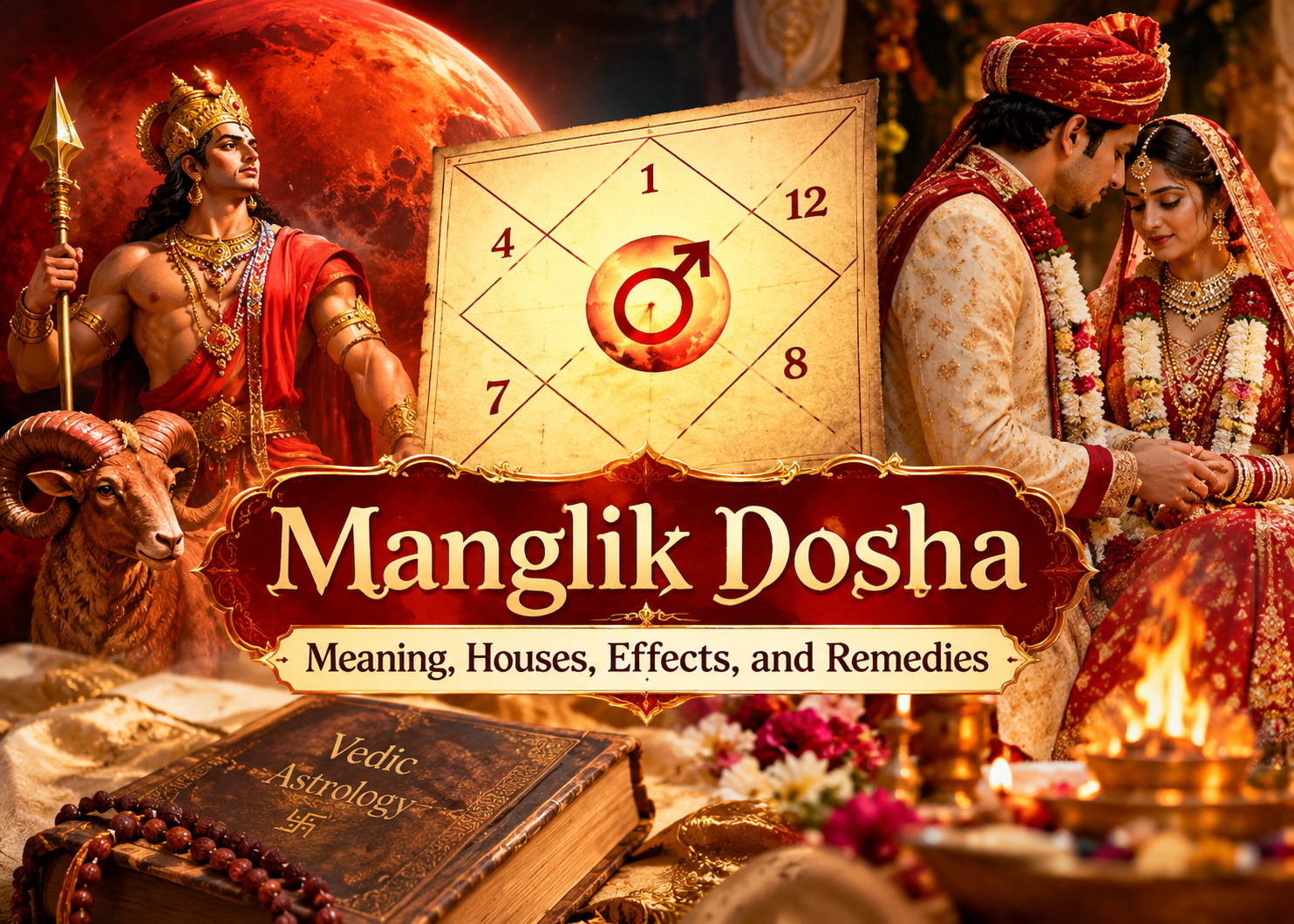
 Table of Contents
 Key takeaways











Leave a Comment