Nadi Dosh in Kundali Matching occurs when both partners have the same Nadi according to their birth Nakshatras. In the standard Ashtakoot Guna Milan system, this combination receives 0 out of 8 points for Nadi Koot, the most heavily weighted individual factor in the 36-point matching system.
Traditional Vedic astrology associates Nadi Koot with physical constitution, health and progeny. However, a same-Nadi result should not automatically determine whether a couple proceeds with marriage. Some Jyotish traditions recognise specific conditions under which Nadi Dosh may be considered cancelled or reduced. An astrologer must examine the relevant rules, verify both birth charts and explain the findings in context.
Understanding the meaning of Nadi Dosh, its traditional interpretation and the limits of Guna Milan can help couples approach a matching report without unnecessary fear.
What Is Nadi Dosh Meaning?
Nadi Dosh is a condition identified during traditional marriage matching when both partners share the same Nadi.
In Ashtakoot Guna Milan, the 27 birth Nakshatras are divided into three Nadi classifications: Aadi, Madhya and Antya. An astrologer identifies each person’s Moon Nakshatra and compares the corresponding Nadi classifications to calculate the Nadi Koot score.
In traditional Vedic astrology, Nadi is associated with physical constitution, health and progeny. This association explains why Nadi Koot receives particular attention during marriage matching. When both partners have the same Nadi, the standard calculation assigns them 0 out of 8 points for this factor.
However, Nadi Dosh is an astrological classification, not a medical diagnosis. It cannot establish whether a couple will conceive, experience health problems or have a child with an inherited condition.
The interpretation also depends on the matching method being followed. Different Jyotish traditions may recognise different Naadi Dosh cancellation conditions or apply familiar rules differently. A responsible assessment should identify the method used instead of presenting every interpretation as universally accepted. For a broader assessment of the traditional compatibility factors, couples can explore Kundali matching for marriage compatibility, which compares the partners’ birth charts within the marriage-matching framework.
What Is Nadi Koot in Ashtakoot Guna Milan?
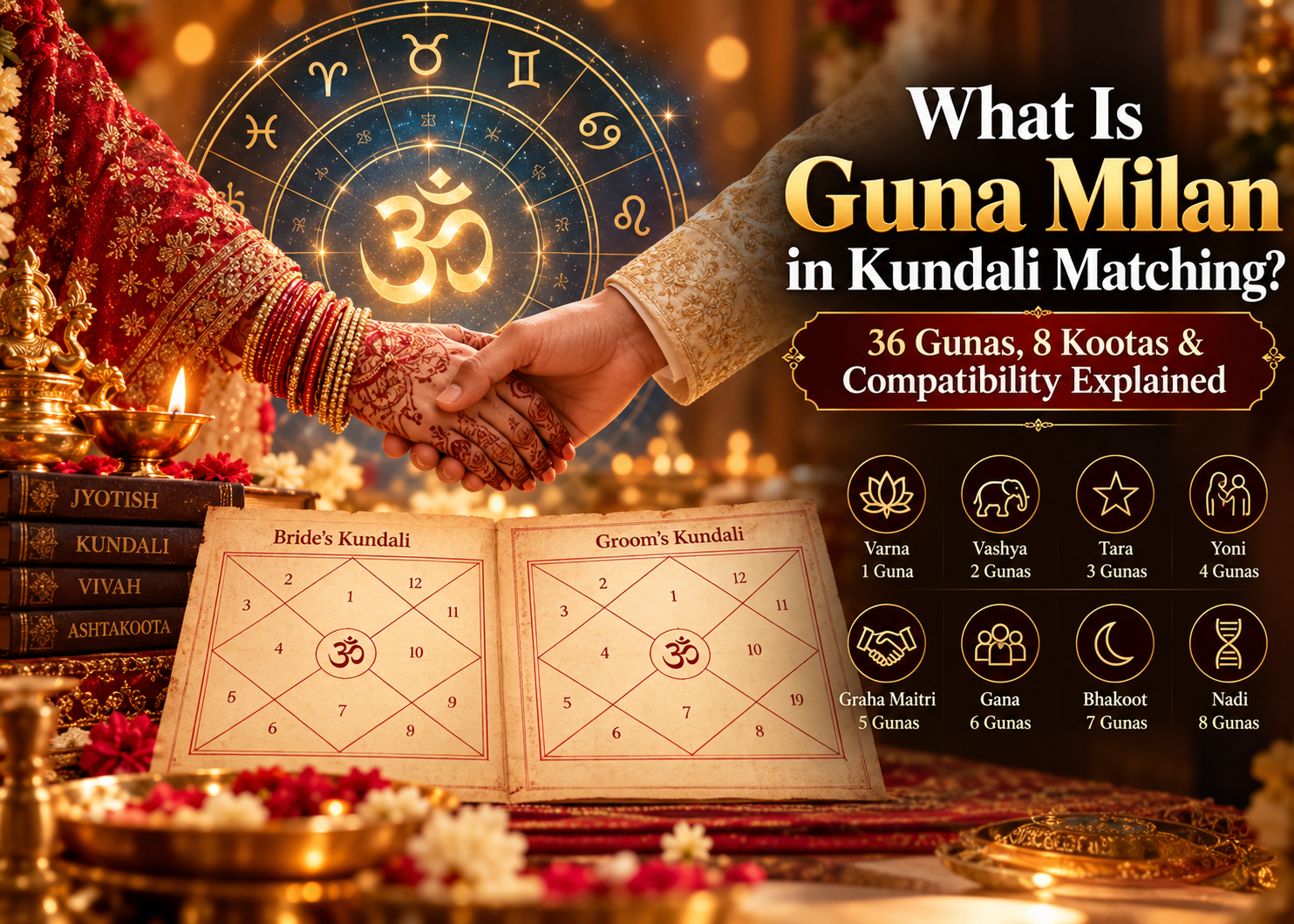
Nadi Koot is one of the eight factors used in Ashtakoot Guna Milan, a traditional Vedic astrology system for comparing two birth charts before marriage. Each Koot contributes a specific number of points to an overall score of 36 Gunas.
Nadi Koot carries 8 points, making it the most heavily weighted individual factor in this system. Its score depends on whether the partners’ Moon Nakshatras belong to the same or different Nadi classifications.
Ashtakoot Guna Milan: Points Breakdown
| Koot |
Maximum points |
| Varna |
1 |
| Vashya |
2 |
| Tara |
3 |
| Yoni |
4 |
| Graha Maitri |
5 |
| Gana |
6 |
| Bhakoot |
7 |
| Nadi |
8 |
| Total |
36 |
When partners have different Nadis, they generally receive all 8 Nadi points. When both belong to the same Nadi, the standard calculation assigns 0 points for Nadi Koot.
The remaining Gunas also contribute to the overall matching result. A high total score does not automatically remove a Nadi Dosh, and a low score does not prove that a marriage will fail. The final interpretation depends on the chosen matching method, the applicable cancellation conditions and the complete assessment.
Types of Nadi in Vedic Astrology
Traditional marriage matching recognises three types of Nadi: Aadi, Madhya and Antya. Each classification contains nine of the 27 birth Nakshatras.
These classifications are traditionally associated with the three Ayurvedic principles of Vata, Pitta and Kapha. The Moon’s birth Nakshatra determines a person’s Nadi in the standard Ashtakoot method; the person’s name or Sun sign does not determine it.
1. Aadi Nadi (Vata)
Aadi Nadi is traditionally associated with Vata, which represents movement and activity in Ayurvedic thought. Its nine Nakshatras are Ashwini, Ardra, Punarvasu, Uttara Phalguni, Hasta, Jyeshtha, Mula, Shatabhisha and Purva Bhadrapada.
This classification identifies a group used in traditional marriage matching. It does not establish that everyone born under these Nakshatras shares the same physical or medical constitution.
2. Madhya Nadi (Pitta)
Madhya Nadi is traditionally associated with Pitta, the Ayurvedic principle linked with heat and transformation. Its nine Nakshatras are Bharani, Mrigashira, Pushya, Purva Phalguni, Chitra, Anuradha, Purva Ashadha, Dhanishta and Uttara Bhadrapada.
During Kundali matching, an astrologer compares the Madhya Nadi classification with that of the other partner to determine the Nadi Koot score.
3. Antya Nadi (Kapha)
Antya Nadi is traditionally associated with Kapha, which represents stability and structure in Ayurvedic thought. Its nine Nakshatras are Krittika, Rohini, Ashlesha, Magha, Swati, Vishakha, Uttara Ashadha, Shravana and Revati.
The Antya Nadi classification identifies the third group in traditional marriage matching. Its association with Kapha belongs to the traditional Ayurvedic framework and should not be treated as a medical assessment of an individual’s constitution.
Readers who want to explore the traditional framework further can consult the Ministry of AYUSH’s Principles of Ayurveda, which explains the concepts of Vata, Pitta and Kapha within Ayurveda.
Nadi Compatibility Chart of All 27 Nakshatras
The following chart presents the commonly used grouping of the 27 birth Nakshatras for Ashtakoot Guna Milan.
| Aadi Nadi (Vata) |
Madhya Nadi (Pitta) |
Antya Nadi (Kapha) |
| Ashwini |
Bharani |
Krittika |
| Ardra |
Mrigashira |
Rohini |
| Punarvasu |
Pushya |
Ashlesha |
| Uttara Phalguni |
Purva Phalguni |
Magha |
| Hasta |
Chitra |
Swati |
| Jyeshtha |
Anuradha |
Vishakha |
| Mula |
Purva Ashadha |
Uttara Ashadha |
| Shatabhisha |
Dhanishta |
Shravana |
| Purva Bhadrapada |
Uttara Bhadrapada |
Revati |
Regional Jyotish traditions and modern matching tools may differ in the cancellation rules they apply. Therefore, verify both partners’ birth Nakshatras using a reliable Panchang or an appropriate calculation method before interpreting the result.
What Is Nadi Maha Dosha and Eka Nadi Dosha?
Some astrologers use the term Nadi Maha Dosha when a same-Nadi combination receives particular attention during marriage matching. However, the term does not have a single, universally applied severity scale across all Jyotish traditions.
Eka Nadi Dosha generally refers to a match in which both partners belong to the same Nadi. The word Eka means one. Some practitioners use this term interchangeably with Nadi Dosh, while others apply it to more specific combinations.
Certain traditions also examine whether both partners share the same Nakshatra and Pada. The astrologer may consider the precise Moon placements, sign lords and relevant cancellation conditions before interpreting such a match.
These labels should not be treated as measurable indicators of medical or relationship risk. If an astrologer identifies Nadi Maha Dosha in a matching report, ask which specific combination the term refers to and which traditional rule supports the interpretation.
How to Check Nadi Dosha in Kundali Matching
You can check Nadi Dosha by following four steps. Accurate birth details are important because the Moon’s Nakshatra determines the Nadi used in the standard calculation.
Step 1: Find both birth Nakshatras. Use each person’s date, time and place of birth to calculate their Moon Nakshatra.
Step 2: Identify each Nadi. Match both Nakshatras with the Aadi, Madhya or Antya classification in the chart above.
Step 3: Compare the Nadis. If both partners share the same Nadi, the standard Ashtakoot calculation assigns 0 out of 8 points to Nadi Koot.
Step 4: Review the matching result. Examine the other Koot scores and check whether any cancellation condition recognised by the chosen Jyotish tradition applies.
Online Kundali matching tools can provide an initial result, but their calculations and cancellation assessments may differ depending on their settings and matching methods. Verify the birth details and calculation method before relying on a report.
Worked Example 1: Same Nadi Without an Established Cancellation
Suppose Partner A has Ashwini Nakshatra in Aries, while Partner B has Ardra Nakshatra in Gemini.
-
Ashwini belongs to Aadi Nadi.
-
Ardra also belongs to Aadi Nadi.
-
Both partners therefore receive 0 out of 8 Nadi points in the standard calculation.
Aries is ruled by Mars, whereas Gemini is ruled by Mercury. The partners have different Moon signs and different sign lords, so the shared-Rashi-lord condition discussed in this article does not apply. Their Nakshatras also differ.
Under the cancellation conditions considered here, these details alone do not establish cancellation. An astrologer should still review the complete charts and any additional rules recognised by the tradition being followed.
This example illustrates the calculation and one method of checking cancellation conditions. It does not predict the couple’s fertility, health or future married life.
Effects of Nadi Dosh on Marriage, Health and Children
Traditional Jyotish associates Nadi Dosh primarily with concerns about physical constitution, health and progeny. This association explains why Nadi Koot receives the highest individual weight in the Ashtakoot Guna Milan system.
Some traditional interpretations link an unaddressed Nadi Dosh with difficulties related to conception, pregnancy or children’s health. Other interpretations focus more broadly on the constitution of the partners. These are traditional astrological beliefs, not established medical outcomes.
Nadi Dosh alone should not be presented as a definitive cause of divorce, illness or a spouse’s death. A same-Nadi result does not establish that these events will occur.
Nadi matching has not been scientifically validated as a reliable method for predicting fertility, children’s health or marital success. Couples planning marriage and children can obtain more direct health information through appropriate medical assessments. A doctor may recommend genetic screening or other tests based on family history, known inherited conditions and individual circumstances. The NHS explains how genetic counselling and testing may help when an inherited condition runs in a family.
The emotional effect of an unfavourable matching report also deserves attention. Couples may experience anxiety, family pressure or unnecessary delays in marriage because of an astrological interpretation. A responsible astrologer should explain the traditional meaning calmly, clarify any applicable cancellation conditions and avoid frightening predictions.
Ultimately, couples can consider their cultural and religious beliefs alongside mutual consent, relationship compatibility, personal circumstances and appropriate medical advice. The World Health Organization’s sexual and reproductive health guidance provides broader information about reproductive healthcare and informed decisions.
Nadi Dosha Cancellation: When Can It Be Considered?
Nadi Dosha cancellation, sometimes called Nadi Dosha Bhanga or Nadi Dosh Nivaran in particular contexts, refers to traditional conditions under which the same-Nadi concern may be considered cancelled or reduced.
Different Jyotish authorities do not apply every cancellation rule in the same way. Some emphasise the relationship between the Moon signs and Nakshatras, while others consider the ruling planets or additional chart factors. The conditions below are commonly discussed in marriage-matching interpretations, but they should not be treated as a universal checklist accepted by every tradition.
Commonly Cited Nadi Dosha Cancellation Rules
| Rule |
What it means |
Important qualification |
| Same Rashi, different Nakshatra |
Both partners have the same Moon sign but different birth Nakshatras. |
Some traditions recognise this combination as a cancellation condition. |
| Same Nakshatra, different Rashi |
Both partners share a Nakshatra that falls in different Moon signs in their respective charts. |
Some methods accept this distinction; exact placements must be verified. |
| Same Nakshatra, different Pada |
Both partners share a Nakshatra but belong to different quarters, called Padas. |
Some traditions recognise this as a cancellation condition, but its application varies. |
| Same or friendly Rashi lords |
The partners’ Moon signs have the same ruling planet or rulers considered friendly under the method being followed. |
Some astrologers treat this as cancellation, while others consider it a mitigating factor. |
These conditions should not be applied mechanically. The astrologer must verify the exact birth details, identify which rules the chosen tradition recognises and explain whether a condition is considered full cancellation or partial mitigation.
A cancellation assessment should also distinguish between the original arithmetic score and the tradition’s interpretation of that score. A report may retain 0 out of 8 as the calculated Nadi Koot result while explaining separately why a recognised exception changes the interpretation.
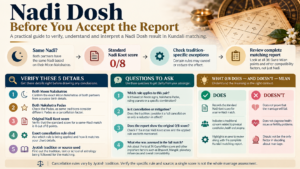
Before accepting a Nadi Dosh result, verify both Moon Nakshatras, the original Nadi Koot score, the cancellation rule and the complete Kundali assessment.
Nadi Dosh Flowchart: How to Check the Four Common Rules
Use the following process to understand how a traditional cancellation assessment may work.
-
Compare both birth Nakshatras. Establish each partner’s Moon Nakshatra and corresponding Nadi.
-
Are the Nadis different? If yes, the standard same-Nadi condition is absent. Continue with the remaining Guna Milan assessment.
-
Are the Nadis the same? Record the standard Nadi Koot score of 0 out of 8, then proceed to the cancellation checks.
-
Check the same-Rashi condition. Do both partners have the same Moon sign but different Nakshatras? If so, verify whether the selected matching tradition recognises this cancellation.
-
Check the same-Nakshatra condition. Do the partners share a Nakshatra but have different Moon signs or Padas? Verify the exact placements and the applicable rule.
-
Check the ruling planets. Are the Moon-sign rulers the same or considered friendly under the chosen method? Ask whether the tradition treats this as cancellation or mitigation.
-
Review the complete Kundali. Record the applicable conditions and explain the conclusion without presenting a tradition-specific interpretation as a universal rule.
Worked Example 2: A Same-Nadi Match With a Possible Cancellation Condition
Suppose Partner A has Ardra Nakshatra in Gemini and Partner B has Hasta Nakshatra in Virgo. Both Nakshatras belong to Aadi Nadi, so the initial Nadi Koot score is 0 out of 8.
Gemini and Virgo are both ruled by Mercury. Some traditional matching methods recognise a shared Moon-sign ruler as a cancellation condition for Nadi Dosh. Under such a method, the concern may be considered cancelled or substantially reduced.
Other practitioners may retain the original Nadi Koot score and explain the cancellation separately. This example shows why an astrologer should identify the exact rule being applied rather than assume that every Jyotish tradition will interpret the combination identically.
Worked Example 3: Same Nadi Without Cancellation Under the Conditions Considered
Suppose Partner A has Ashwini Nakshatra in Aries and Partner B has Punarvasu Nakshatra in Gemini. Both Nakshatras belong to Aadi Nadi, so the standard calculation gives 0 out of 8 Nadi points.
Their Moon signs are different, their Nakshatras are different, and their Moon-sign rulers are Mars and Mercury, respectively. The pair therefore does not meet the same-Rashi, same-Nakshatra or shared-Rashi-lord conditions discussed in this article.
These conditions alone do not establish cancellation for this example. An astrologer may still examine additional exceptions accepted by the relevant tradition and assess the complete charts before reaching a conclusion.
Other Chart Factors an Astrologer May Examine
Nadi Koot is only one component of traditional marriage assessment. A Jyotish practitioner may also examine the 7th house and its lord for partnership-related themes, Venus for relationship themes, Jupiter’s placement and aspects, and relevant Dasha periods.
These factors help the astrologer develop a broader traditional interpretation rather than relying on one matching score. They should not be presented as scientific guarantees of marital success, conception or a child’s health.
A complete consultation should explain which chart factors were considered, how they relate to the question being asked and where the method’s interpretive limits lie.
Is It Okay to Marry With Nadi Dosh?
A same-Nadi result does not automatically mean that a couple must cancel its wedding plans. The next step depends on the applicable cancellation conditions, the broader matching assessment and the couple’s real-life compatibility.
| Situation |
What it means |
Recommended next step |
| Nadi Dosh is considered cancelled under an accepted rule |
The chosen matching method recognises a condition that removes or reduces the concern. |
Ask the astrologer to explain the rule and review the complete charts. |
| Nadi Dosh is present with a high total score, such as 28/36 |
The couple scores well across several Koots, but Nadi Koot still scores 0 unless cancellation is recognised separately. |
Review the remaining chart factors and discuss the interpretation calmly. |
| Nadi Dosh is present with a low total score, such as 16/36 |
Several matching factors may require closer examination, not just Nadi Koot. |
Seek a careful assessment and consider shared values, communication and readiness for marriage. |
A total Guna Milan score above 18 does not automatically cancel Nadi Dosh. The overall score and the individual Nadi Koot result represent separate elements of the traditional matching system.
Beyond chart matching, couples should discuss the practical responsibilities of married life. Conversations about finances, children, family expectations, work, living arrangements and personal boundaries can help them assess whether they are ready to build a life together.
The decision should consider both partners’ wishes, mutual consent and real-world compatibility. An astrological score should not replace open communication or become the sole basis for a life-changing decision. Couples seeking a broader traditional assessment of relationship timing and prospects can also explore Marriage Prediction to understand the questions that a separate marriage-focused reading may address.
Nadi Dosh Ke Upay: Traditional Remedies
Nadi Dosh Ke Upay are religious practices that some families follow when a same-Nadi match raises concern. The choice of remedy depends on family tradition, the advice of a qualified priest or astrologer and the couple’s beliefs.
No ritual has been scientifically shown to prevent a medical or marital outcome attributed to Nadi Dosh. These practices are best understood as expressions of faith, devotion or spiritual reassurance rather than guarantees of a particular result.
1. Nadi Dosh Nivaran Puja
Nadi Dosh Nivaran Puja is performed by some families to seek divine blessings and peace before marriage. Depending on the tradition, the ceremony may include Sankalp, prayers, mantra recitation, offerings and a Havan.
The exact procedure varies between temples, families and regional practices.
-
Who performs it: A trained priest or Pandit familiar with the prescribed ritual.
-
When to perform it: Families may arrange the Puja before the wedding after consulting their priest about an appropriate Muhurta.
-
How long it takes: The duration depends on the ceremony. A simple Puja may take around one to three hours, while more elaborate rituals can take longer.
-
What it costs: There is no fixed national rate. Fees depend on the location, priest, ritual materials and Havan arrangements.
Before booking, ask which procedure the priest will perform, what the fee includes and whether additional offerings or ceremonies are required. Be cautious of anyone who promises that a ritual will guarantee fertility, prevent illness or ensure a successful marriage.
2. Maha Mrityunjaya Mantra
Some families recite the Maha Mrityunjaya Mantra as a prayer for well-being, peace and divine protection. The Shiva mantra may form part of personal worship or a priest-led Sankalp.
A simple devotional practice involves sitting in a clean, quiet place, remembering Lord Shiva and reciting the mantra with devotion. Some practitioners choose to repeat it 108 times using a mala, although this is a devotional practice rather than a compulsory prescription for every Nadi Dosh case.
If a priest recommends a longer Anushthan, ask about the number of repetitions, duration, arrangements and purpose of the ceremony. Follow the practice that suits your beliefs without feeling pressured to purchase an expensive ritual.
3. Daan (Charitable Donations)
Daan is an established practice in Hindu tradition. Families may make charitable donations as an act of devotion or goodwill during a Puja or religious occasion.
Depending on local custom, donations may include food grains, clothes, meals for people in need or contributions to a temple or charitable cause. Some traditions prescribe specific items, but there is no single donation package followed by every Jyotish school for Nadi Dosh.
Give according to your means. The purpose should be charity and devotion, not the belief that a more expensive donation will produce a better astrological outcome.
4. Symbolic Marriage to Lord Vishnu
Some Hindu ritual traditions prescribe a symbolic marriage or ceremonial offering to Lord Vishnu in specific circumstances. Families following a particular regional or priestly tradition may seek guidance about whether this practice applies to them.
This ceremony is not a universal remedy for every same-Nadi match. The priest should explain its religious basis, procedure and suitability for the family’s circumstances. Do not assume that it is compulsory or that every astrologer will recommend it.
Precautions Before Performing Nadi Dosh Remedies
Before arranging any remedy, ask for a clear explanation of the Nadi calculation, the cancellation conditions considered and the reason for the recommendation. Seek a second opinion when necessary, particularly if someone makes alarming predictions or demands substantial payment to avert a claimed misfortune.
A responsible practitioner should explain the options without threatening the couple with illness, separation or other misfortune. If you have concerns about fertility or inherited health conditions, consult a qualified medical professional.
Nadi Dosh vs Mangal Dosh vs Bhakoot Dosh
Nadi Dosh, Mangal Dosh and Bhakoot Dosh are separate concepts in traditional Vedic astrology. They arise from different aspects of chart interpretation and should not be treated as interchangeable.
| Factor |
Points in Ashtakoot |
Traditional area of concern |
How it is assessed |
| Nadi Dosh |
8 |
Physical constitution, health and progeny |
Compare the birth Nakshatras, Nadis and applicable cancellation conditions. |
| Mangal Dosh |
Not a separate Ashtakoot category |
Marriage and partnership themes associated with Mars |
Examine Mars’s placement, the Ascendant and other relevant chart factors under the chosen method. |
| Bhakoot Dosh |
7 |
Emotional compatibility, family life and shared prosperity |
Compare the Moon signs and relevant planetary relationships. |
Nadi Koot and Bhakoot Koot have their respective weights within Ashtakoot Guna Milan. Mangal Dosh is assessed separately and does not carry its own point allocation in the 36-point system.
Traditional exceptions and mitigating factors may apply to these classifications, depending on the method being followed. None should be used alone to predict the success or failure of a marriage. Within the Jyotish framework, the complete chart and the practitioner’s stated method remain important to the interpretation.
Special Cases of Nadi Dosh
Nadi Dosh in Love Marriage
Love marriages follow the same basic Nadi matching calculation as arranged marriages. Couples may compare their birth charts if they wish to follow this tradition, but a same-Nadi result should not override mutual consent, respect or an honest understanding of their future together.
For couples who also want to explore traditional astrological interpretations of romance and relationship dynamics, Love Life Prediction by Date of Birth addresses a related but distinct aspect of relationship-focused astrology.
Nadi Dosh in Second Marriage
For a second marriage, an astrologer may examine the relevant birth-chart factors alongside the circumstances of the new relationship. The presence of Nadi Dosh should not be treated as a fixed prediction about the outcome of the second marriage.
Nadi Dosh Discovered After Marriage
If you discover Nadi Dosh after marriage, there is no reason to panic or assume that something bad will happen. You may seek a calm review of the charts for your own understanding or peace of mind, but an astrological label should not create unnecessary fear or conflict in your relationship.
The same principle applies after marriage as before it: understand the traditional interpretation in context and avoid treating one matching factor as a definitive prediction of the future.
Final Thoughts on Nadi Dosh
Nadi Dosh deserves careful interpretation within traditional Kundali matching, but it should not become a source of fear for couples planning marriage. The standard calculation assigns 0 out of 8 points when both partners share the same Nadi, while some Jyotish traditions recognise specific cancellation or mitigation conditions.
The appropriate next step is to verify the birth details, understand the matching method being used and examine the applicable rules before drawing conclusions. Couples may also consider religious practices that are meaningful to them, alongside real-life compatibility and appropriate medical guidance where relevant.
If you need help understanding a matching report, consult Astrologer Ammit Kapur for a clear explanation of the calculations, the traditional rules being applied and the limitations of the interpretation. Learn more about the services offered by the best astrologer in India. A useful consultation should help you understand your options without relying on fear or promises of guaranteed results.

 Table of Contents
 Key takeaways


Leave a Comment