Introduction:
When a Kundli shows Mangal Dosh, marriage discussions can become stressful, especially when one partner is Manglik and the other is non-Manglik. Families often want to know whether the dosh can delay marriage, cause disagreements between spouses or affect marital happiness. The term ‘Anshik Manglik’ raises major questions, like what does it mean, and how does it affect marriage according to Vedic astrology?
In Vedic astrology, Mangal Dosh is commonly assessed when Mangal (Mars) occupies the first, second, fourth, seventh, eighth or twelfth house of the birth chart, although the houses considered can vary across Jyotish traditions and methods. Each house represents a specific area of life and influences how Mars is interpreted in a person’s horoscope. Therefore, Mars in the seventh house is interpreted differently from Mars in the fourth or eighth house. The sign occupied by Mars, its relationship with other planets, and the condition of the houses connected with marriage also matter. This is why the presence of Manglik Dosh alone does not explain the complete picture of a horoscope.
Anshik Manglik Dosh does not automatically mean an unhappy marriage, separation or delayed marriage. The term generally describes a partial or modified Manglik classification used in some Jyotish traditions. Its precise meaning depends on the rules followed by the astrologer and the planetary combinations in the birth chart. Families considering traditional Kundli matching can also explore Kundali Matching by Name and Date of Birth to understand how compatibility is considered.
What Is Anshik Manglik Dosh? Mars in Different Houses
To understand what Anshik Manglik is, it is important to know how Mars is traditionally examined in the birth chart. Each house represents a particular part of life, and Mars in these houses brings different subjects into the marriage-related reading.
The following sections explain the traditional meaning of each placement. These are astrological beliefs, not guaranteed events in a person’s life.
-
Mars in the First House: Temperament and Behaviour
The first house, also called the Lagna Bhava, represents the individual, temperament, physical vitality and general approach to life.
Mars is associated with courage, initiative and assertiveness. When Mars occupies the first house, the traditional reading examines how these qualities may appear in a person’s behaviour.
A challenging placement of Mars may be associated with impatience, quick reactions or a forceful way of expressing opinions. In married life, these tendencies may become relevant when partners disagree about decisions or expectations.
Mars can also represent confidence, determination and the willingness to take responsibility. Therefore, this placement should not automatically be treated as negative.
What should be checked? The sign occupied by Mars, the condition of the Lagna and its lord, the planets aspecting Mars, and the seventh house connected with marriage. These details help explain how Mars is traditionally understood in the chart.
-
Mars in the Second House: Family, Speech and Finances
The second house represents family life, speech, accumulated wealth and the values a person learns within the family. Mars in this house is examined in relation to communication, family interactions and financial decisions.
A challenging placement may be associated with blunt speech, arguments over money or disagreements about family responsibilities. These matters can become important after marriage when partners have different expectations about spending, saving or involvement with relatives.
However, Mars in the second house does not prove that a person will be rude, financially irresponsible or unable to maintain family relationships.
What should be checked? The second house, its ruling planet, Mars’s sign and the planets influencing it. The seventh house may also be considered when examining how family expectations relate to marriage.
Before marriage, couples can discuss finances, living arrangements, family involvement and how they prefer to resolve disagreements. These conversations help address practical concerns rather than relying on a Manglik label alone.
-
Mars in the Fourth House: Home and Domestic Peace
The fourth house represents home, property, domestic comfort and emotional security. Mars in this house is traditionally examined when discussing peace within the home and adjustment to family life.
A challenging placement may be associated with disagreements over household responsibilities, property matters or decisions about where the couple will live. It may also bring attention to how each partner reacts when domestic expectations differ.
Mars can also represent the drive to protect, build or improve a home. Its placement should be examined alongside the other planets rather than treated as a guarantee of conflict.
What should be checked? Mars’s sign and the planets aspecting it, the fourth house and its ruling planet, and the seventh house connected with marriage.
Couples can also discuss household responsibilities, career plans, living arrangements and the role of extended family before marriage. These subjects often matter more to day-to-day harmony than a single chart placement.
-
Mars in the Seventh House: Marriage and Partnership
The seventh house is directly associated with marriage, the spouse and committed partnerships. For this reason, Mars in the seventh house receives particular attention during the Mangal Dosh assessment.
Mars represents energy, passion, assertiveness and the desire to take action. A challenging placement may traditionally be associated with arguments, competition between partners or a tendency to insist on one’s own decisions.
The same Mars placement may also be associated with passion, initiative and decisiveness. Its effect in a traditional reading depends on the sign occupied by Mars, its condition and the other planets connected with the seventh house.
What should be checked? The seventh house, its ruling planet, Mars’s sign and the planets influencing both Mars and the seventh house. Venus (Shukra) and other marriage-related factors may also be examined under the chosen Jyotish method.
Mars in the seventh house alone does not prove that a marriage will fail. The complete Kundli and the couple’s real-life compatibility must also be considered.
-
Mars in the Eighth House: Shared Responsibilities and Major Changes
The eighth house is linked with shared resources, sudden changes, joint financial responsibilities and major transitions in life. In marriage-related astrology, Mars in this house is examined because married life can involve shared responsibilities and unexpected challenges.
A difficult situation may often bring attention to conflicts over shared finances and difficulty in adjusting to changes when one partner feels insecure. However, Mars in the eighth house does not prove that a person will experience separation, financial loss or an unhappy marriage.
What should be checked? The eighth house, its ruling planet, Mars’s sign and the planets influencing it. The seventh house and its lord are also important when the concern relates to married life.
Couples can prepare for practical responsibilities by discussing savings, debt, family obligations and how they would manage unexpected expenses. These conversations help build trust regardless of either partner’s Manglik status.
-
Mars in the Twelfth House: Private Life, Intimacy and Expenses
The twelfth house represents private life, sleep, intimacy, expenditure and time spent away from public responsibilities. Mars in this house is traditionally examined in relation to personal space, private needs and shared spending.
A challenging placement may be associated with disagreements over expenses, restlessness or difficulty balancing personal needs with a partner’s expectations. Some Jyotish traditions also examine this house when discussing intimacy in married life.
These are possible themes within a traditional reading, not fixed outcomes. Mars in the twelfth house does not prove that a person will have intimacy problems, hidden conflicts or financial instability.
What should be checked? The twelfth house and its ruling planet, Mars’s sign, and the planets influencing it. The seventh house and other marriage-related factors provide additional context.
Before marriage, partners can discuss privacy, personal boundaries, expenses and expectations around emotional and physical intimacy. Clear communication helps both people understand each other’s needs.
Why the Complete Kundli Matters
The house occupied by Mars is an important starting point, but it does not tell the whole story. Two people may both have Mars in the seventh house, yet the signs, planetary influences and other parts of their birth charts may differ.
A detailed Mangal Dosh check considers:
- The house and sign occupied by Mars.
- The Lagna and the chart method are used to check Mangal Dosh.
- The ruling planet of the house occupied by Mars.
- Other planets placed with or aspecting Mars.
- The seventh house and its ruling planet when the question concerns marriage.
- Traditional conditions that may reduce or cancel Mangal Dosh.
- The exact meaning of Anshik Manglik varies across Jyotish traditions, so the classification should be explained through the actual planetary positions and assessment method.
This is why a person should not be judged only by the words ‘Manglik’ or ‘Anshik Manglik’. The actual planetary positions and the rules used to assess them need to be explained.
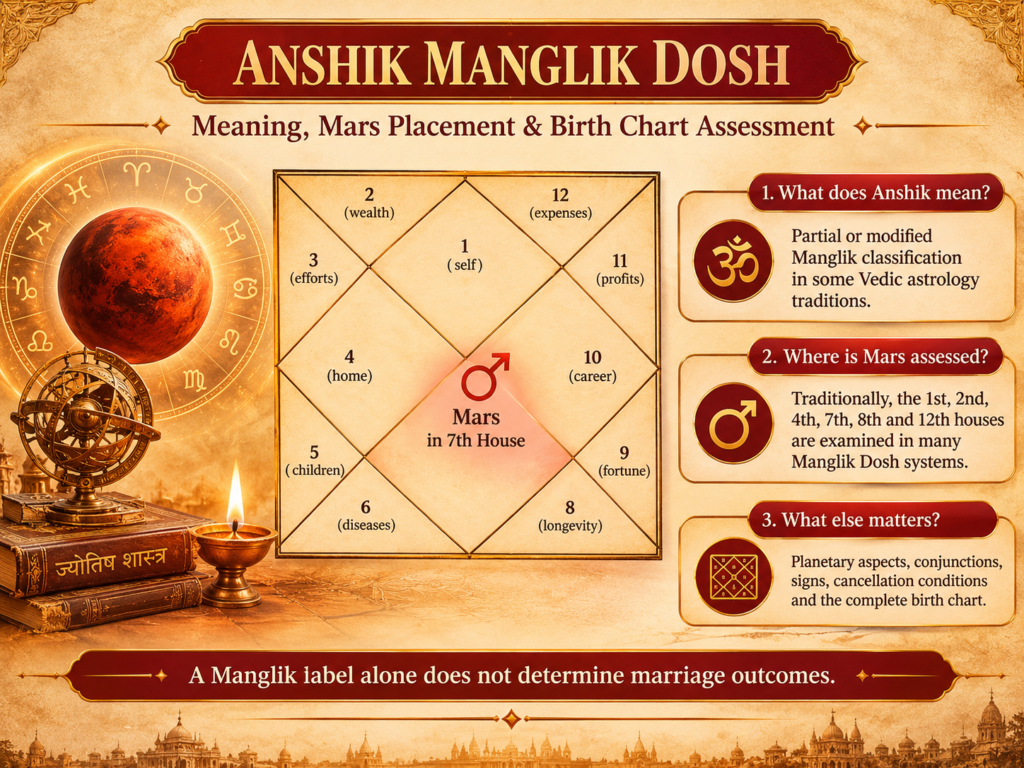
Understand Anshik Manglik Dosh, the houses traditionally assessed for Mars, and why astrologers consider the complete birth chart.
Anshik Manglik Meaning in Simple Words
Anshik Manglik generally means that a person has a partial Manglik condition according to the Jyotish method being followed. It does not mean that the person has only a partial chance of having a successful marriage.
For example, Mars may occupy a house associated with Mangal Dosh, but other planetary positions may be considered to reduce or change its effect under a particular tradition. The complete Kundli must be checked before reaching a conclusion.
Anshik Manglik Meaning in Hindi
आंशिक मांगलिक दोष क्या है?
आंशिक मांगलिक दोष मंगल ग्रह की स्थिति से जुड़ा एक ज्योतिषीय वर्गीकरण है। कुछ वैदिक ज्योतिष परंपराओं में इसे मंगल दोष के सीमित या संशोधित रूप के तौर पर समझा जाता है। इसकी जाँच मंगल के भाव, राशि, अन्य ग्रहों की दृष्टि और कुंडली में मौजूद दोष-निवारण योगों के आधार पर की जा सकती है।
विवाह के लिए मंगल की स्थिति के साथ लग्न, सप्तम भाव, सप्तमेश और अन्य संबंधित ग्रहों को भी देखा जाता है। केवल आंशिक मांगलिक होने से विवाह असफल होने, शादी में देरी होने या जीवनसाथी के अनुपयुक्त होने का निश्चित निष्कर्ष नहीं निकाला जा सकता।
आंशिक मांगलिक होने के फायदे और नुकसान
पारंपरिक ज्योतिष में मंगल को ऊर्जा, साहस, आत्मविश्वास और पहल से जोड़ा जाता है। इसलिए कुछ व्याख्याओं में मंगल की स्थिति को सकारात्मक गुणों से भी जोड़ा जा सकता है।
दूसरी ओर, कुछ ज्योतिषीय व्याख्याएँ चुनौतीपूर्ण मंगल स्थिति को जल्दबाजी, अधीरता या बहस की प्रवृत्ति से जोड़ती हैं। लेकिन इन गुणों को हर आंशिक मांगलिक व्यक्ति पर लागू करना सही नहीं होगा।
फायदे और नुकसान की कोई एक निश्चित सूची हर कुंडली पर लागू नहीं होती। किसी व्यक्ति के स्वभाव और विवाह की गुणवत्ता को समझने के लिए वास्तविक व्यवहार, संवाद और आपसी सम्मान पर ध्यान देना आवश्यक है।
Anshik Manglik vs Purna Manglik: What Is the Difference?
Anshik Manglik and Purna Manglik are terms used in some Vedic astrology traditions to describe different forms of Mangal Dosh. Anshik generally refers to a partial condition, while Purna refers to a fuller Manglik condition under the method being followed.
There is no single set of rules used identically by every Jyotish tradition. The difference should therefore be explained through the actual planetary positions and the rules applied to the Kundli.
|
Basis
|
Anshik Manglik
|
Purna Manglik
|
|
Meaning
|
Anshik Manglik refers to a Kundli in which Mangal Dosh is considered present, but its influence may be reduced due to favourable planetary positions or recognised dosha-bhanga yogas.
|
Purna Manglik refers to a Kundli in which Mangal Dosh is considered more pronounced, with fewer or no recognised factors reducing its influence.
|
|
Mars Placement
|
Mars may occupy the 1st, 2nd, 4th, 7th, 8th or 12th bhav. Its sign, strength and position from Lagna, Chandra or Shukra may affect the assessment.
|
Mars occupies one or more of the houses considered for Mangal Dosh, and its placement continues to be significant after examining the relevant reference points in the Kundli.
|
|
Influence of Other Grahas
|
Favourable graha drishti, planetary conjunctions (yuti), Mars’s sign placement and recognised dosha-bhanga yogas may reduce the influence of Mangal Dosh.
|
The influence of Mangal Dosh may be considered stronger when Mars is afflicted and favourable planetary combinations or recognised dosha-bhanga yogas do not sufficiently reduce its effects.
|
|
Marriage Matching
|
The Manglik status is compared with the prospective partner’s Kundli. The 7th bhav, its lord, Shukra and other marriage-related factors are also examined.
|
Both birth charts are examined, including Mars’s placement, the 7th bhav, its lord, Shukra and other factors related to married life.
|
|
Marriage Outcome
|
Anshik Manglik’s status alone cannot determine whether a person will experience problems in married life.
|
Purna Manglik status alone cannot determine the success or failure of a marriage.
|
The useful question is not simply whether a person is Anshik or Purna Manglik. It is which planetary positions led to that result and how the condition is traditionally understood in the complete Kundli.
What Are the Effects of Anshik Manglik Dosh?
The effects associated with Anshik Manglik Dosh depend on the house occupied by Mars and the other planetary positions in the Kundli. In traditional astrology, Mars represents energy, courage and assertiveness. Challenging placements may also be associated with impatience, strong reactions or disagreements.
These associations do not mean that every Anshik Manglik person will have an argumentative nature or face problems in married life.
-
Communication and Arguments
Mars in the first house brings attention to temperament and quick reactions. In the second house, the focus includes speech, family interactions and financial disagreements. In the seventh house, the reading relates more directly to the way partners deal with one another.
A challenging Mars placement is traditionally be associated with speaking impulsively or taking a strong position during disagreements. However, these traits cannot be assumed from the Manglik label alone.
Communication depends on a person’s habits, emotional awareness and willingness to listen. No planetary placement should be used to excuse disrespectful behaviour.
-
Emotional Understanding Between Partners
The Moon is associated with the mind and emotions in Vedic astrology, while Mars represents action and assertiveness. When a marriage-related concern arises, the Moon, Mars and seventh house all considered.
A Kundli cannot establish with certainty whether someone will be caring, dependable or emotionally available. These qualities become clearer through behaviour, trust and the way both partners handle difficult conversations.
-
Adjustment After Marriage
Mars in the fourth house brings attention to home and domestic peace. Mars in the second house relates to family life and speech, while Mars in the seventh house is examined in relation to partnership.
These placements do not guarantee adjustment problems. Couples can prepare for married life by discussing household duties, finances, career plans, children and expectations about extended family.
Traditional marriage readings examine the seventh house, its ruling planet, Venus, Jupiter, Saturn, planetary periods and relevant transits.
Anshik Manglik Dosh alone does not establish that marriage will be delayed. Personal readiness, education, career goals, family circumstances and finding a compatible partner also affect marriage timing.
-
Family Concerns About Compatibility
Manglik status can become a concern when families follow traditional Kundli matching. They question a match because one person is Manglik and the other is non-Manglik.
A clear explanation of both charts can help families understand the basis of the concern. A single planetary label should not create fear or become the only reason for accepting or rejecting a marriage proposal.
-
Does Anshik Manglik Dosh Cause Separation or Divorce?
Anshik Manglik Dosh does not prove that a person will experience separation or divorce. Traditional marriage readings examine the seventh house, its ruling planet, Mars and other relevant factors when discussing relationship challenges.
However, a chart placement cannot establish that a marriage will fail. Relationship difficulties involve trust, communication, safety, finances, family circumstances and individual choices.
-
Can Anshik Manglik Dosh Have Positive Effects?
Mars is also associated with courage, determination, initiative and the willingness to take action. Depending on the Kundli, these qualities may be viewed as strengths.
Confidence and decisiveness can support a relationship when expressed with respect and consideration for the other person. However, Anshik Manglik status does not automatically give someone these qualities. Character is better understood through behaviour and choices.
Can Anshik Manglik Marry a Non-Manglik? Whom Can an Anshik Manglik Marry?
Yes, an Anshik Manglik can marry a non-Manglik or another Manglik. There is no universal rule in Vedic astrology that requires a person with Mangal Dosh to marry only someone with the same dosh. The decision should not depend on the Manglik label alone. The planetary positions in both Kundlis and the marriage-related yogas must be considered.

Anshik Manglik can marry a Non-Manglik or Manglik individual. Complete Kundli matching is essential for assessing marriage compatibility.
Why Do Some Families Believe a Manglik Should Not Marry a Non-Manglik?
This belief is connected with traditional concerns about Mangal Dosh and its possible influence on married life. Mars (Mangal) represents energy, courage, passion and assertiveness. When Mars occupies certain houses, particularly the 7th or 8th bhav, some Jyotish traditions associate its challenging placement with disagreements, marital difficulties or concerns about the spouse’s well-being.
This has led some families to prefer Manglik-Manglik marriage matching. However, it is not correct to assume that every Manglik-Non-Manglik marriage will face difficulties. Anshik Manglik Dosh may also be reduced by favourable planetary placements and recognised dosha-bhanga yogas. The 7th bhav, its lord, Mars’s strength and the overall compatibility of both birth charts are important before reaching a conclusion.
Does Mangal Dosh Cause the Death of a Spouse?
One of the most frightening beliefs associated with Mangal Dosh is that a Manglik person may cause the death of their spouse if they marry a non-Manglik. This fear is sometimes described in families as a Manglik-related death dosh.
However, Mangal Dosh should not be treated as a definite prediction of a spouse’s death. Mars in the 7th or 8th house does not, by itself, establish such an outcome. These houses have specific meanings in Vedic astrology, but their placement must be understood alongside the complete Kundli. No single planetary position is sufficient to make a prediction about a person’s death or the death of their spouse. There is also no scientific evidence that Manglik status causes a spouse’s death.
Whom Can an Anshik Manglik Marry?
An Anshik Manglik can consider marriage with:
- A Non-Manglik: A possible match when the complete Kundli matching and other compatibility factors are favourable.
- Another Anshik Manglik: Both charts should be checked to understand Mars’s placement and the influence of other planets.
- A Purna Manglik: The difference in Manglik status does not automatically make the match unsuitable. The complete planetary combinations and marriage-related houses need attention.
The important point is that Manglik status alone cannot decide whether two people should marry. Guna Milan, the 7th bhav, its lord, Venus (Shukra), Jupiter (Guru), Mars’s placement and dosha-bhanga yogas all provide relevant information within Vedic astrology. Equally important are mutual respect, emotional understanding, consent and shared expectations.
A marriage should not be rejected solely because one person is Anshik Manglik and the other is Non-Manglik.
Common Myths About Anshik Manglik and Non-Manglik Marriage
The term Mangal Dosh often creates unnecessary fear during marriage discussions. These are some common misconceptions that need to be understood correctly:
Myth 1: A non-Manglik partner will suffer after marrying an Anshik Manglik.
This is not an established rule of Vedic astrology. The presence of Anshik Manglik Dosh does not automatically indicate harm to the spouse. The complete Kundli, including the 7th bhav and other marriage-related planets, must be considered before drawing conclusions.
Myth 2: Anshik Manglik and Non-Manglik marriage always leads to divorce.
Mangal Dosh alone cannot determine separation or divorce. The 7th house, its lord, Venus, Jupiter and the planetary periods (Dasha) all contribute to the traditional assessment of married life. No single planetary placement should be treated as a definite prediction of divorce.
Myth 3: Every Manglik person must marry another Manglik.
This is not a universal rule. Matching a Manglik Kundli with another Manglik Kundli is one approach followed in some marriage traditions, but it is not the only acceptable option. A Non-Manglik match can also be considered when the complete birth charts show favourable marriage combinations.
Myth 4: Every Anshik Manglik must perform Kumbh Vivah before marriage.
Kumbh Vivah is a ritual associated with certain Manglik-related beliefs, but it is not compulsory for every Anshik Manglik person. Remedies should never be prescribed merely because the Kundli carries this label. The actual placement of Mars, dosha-bhanga yogas and other planetary influences must guide that decision.
What Does Science Say About Manglik and Non-Manglik Marriage?
From a scientific perspective, there is no established evidence that the position of Mars in a person’s birth chart determines marital compatibility, causes harm to a spouse or predicts divorce. Scientific research has not established Anshik Manglik Dosh as a measurable cause of relationship problems.
A person’s married life is influenced by several real-world factors, including communication, mutual respect, emotional maturity, financial understanding, shared values and the ability to resolve disagreements. These factors should receive serious attention during marriage decisions.
Vedic astrology offers a traditional framework for examining planetary positions and marriage compatibility, but Mangal Dosh should not become a reason for fear or an automatic rejection of a suitable partner. A balanced decision considers the complete Kundli alongside the couple’s understanding, expectations and readiness for marriage.
What Couples Should Check Before Marriage?
For couples who follow Vedic astrology, the following steps can help make Kundli matching clearer:
- Confirm birth details: Accurate date, time and place are important for preparing the birth charts.
- Understand the Manglik status: Identify the house occupied by Mars and the method used to check Mangal Dosh.
- Check the complete Kundli: Examine Mars’s sign, the planets influencing it, the seventh house and its ruling planet.
- Understand cancellation rules: Ask which specific planetary combinations are considered relevant under the chosen tradition.
- Discuss practical matters: Talk about finances, career goals, children, household responsibilities and family expectations.
- Avoid fear-based decisions: Do not reject a suitable partner or accept an unwanted marriage solely because of Manglik status.
- Treat remedies as a matter of faith: Traditional practices should not be presented as guaranteed ways to control marriage outcomes.
Kundli matching may be meaningful to families who value Vedic astrology, but it should complement conversations about mutual respect, consent, safety and shared expectations.
Can Anshik Manglik Marry Another Manglik?
Yes. An Anshik Manglik can marry another Manglik. Some traditional Kundli matching methods consider the Manglik status of both partners when assessing compatibility. However, having the same Manglik status does not automatically mean that the charts are compatible. The full Kundli and the couple’s real-life expectations still matter.
Anshik Manglik Ki Shadi Kisse Hoti Hai?
According to traditional Jyotish practices, an Anshik Manglik may marry a Manglik or non-Manglik partner. The assessment depends on the method used, both birth charts and the family’s beliefs. There is no single universal rule that every Anshik Manglik must marry only another Manglik.
Anshik Manglik Marriage Age: Is There a Fixed Age?
There is no single age at which an Anshik Manglik person will marry. Mangal Dosh alone does not determine marriage timing.
In traditional Vedic astrology, the seventh house, its ruling planet, Venus, Jupiter, Saturn, planetary periods and relevant transits may be examined when discussing possible marriage periods.
Which Houses and Planets Are Checked for Marriage Timing?
- Seventh house: The seventh house represents marriage and committed partnerships. Its ruling planet and the planets influencing it are commonly examined when assessing marriage prospects.
- First house: The first house represents the individual and their general approach to life. Its condition provides context for the birth chart as a whole.
- Second house: The second house relates to family life, speech and accumulated wealth. It may be considered when discussing family formation and responsibilities after marriage.
- Venus (Shukra): Venus is commonly examined in relationship-related readings because it is associated with affection and partnership.
- Jupiter (Guru): Jupiter may be considered for marriage-related matters according to the Jyotish method being followed.
- Saturn (Shani): Saturn may be examined when a traditional reading discusses responsibility, commitments or possible delays. Its presence does not automatically mean late marriage.
- Mahadasha and Antardasha: These planetary periods are used in some Jyotish methods to discuss periods that may be considered favourable for marriage.
- Planetary transits: The current movements of planets may also be examined in relation to the birth chart.
These are traditional astrological methods, not scientifically established ways to predict an exact marriage age. Personal readiness, family circumstances, career plans and finding a compatible partner also affect when someone marries.
Remedies for Anshik Manglik Dosh
Anshik Manglik Dosh does not automatically mean that a person will face problems in marriage. In Vedic astrology, the need for remedies depends on Mars’s placement in the Kundli, its strength, the influence of other planets and the overall condition of the seventh house, which is associated with marriage.
The purpose of traditional remedies is to address astrological concerns associated with Mangal Dosh when the complete Kundli indicates that they may be appropriate. A remedy should not be recommended merely because a person has been labelled Anshik Manglik.
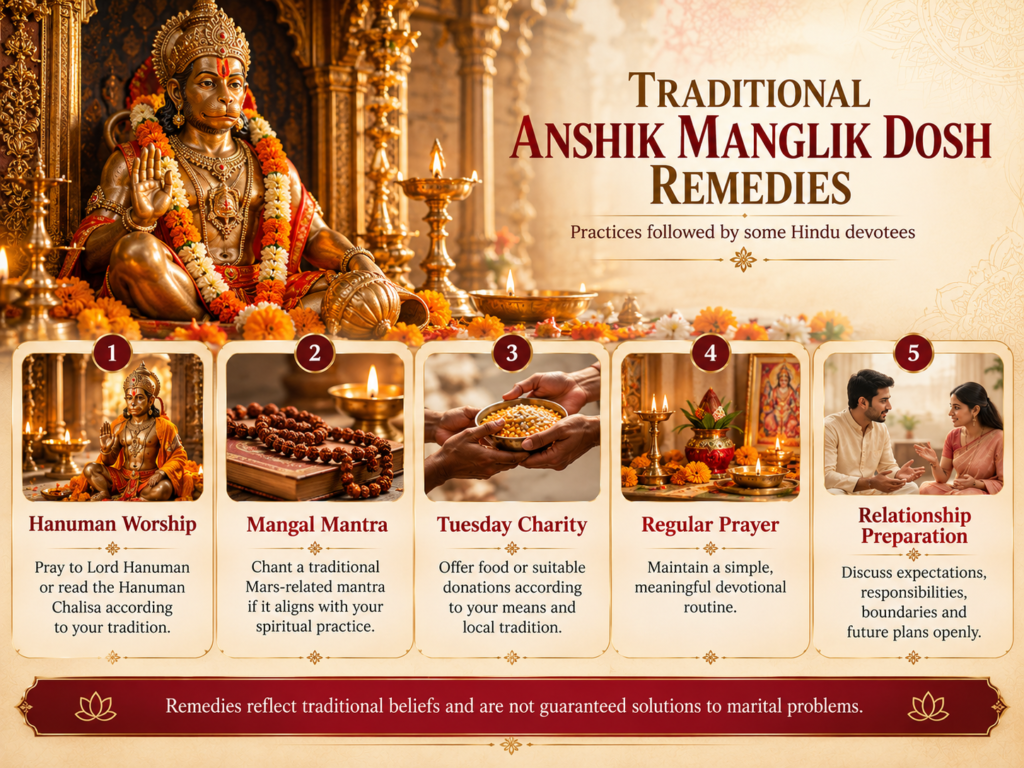
Explore traditional spiritual practices associated with Anshik Manglik Dosh, alongside practical steps for building a healthy relationship.
1. Worship of Lord Hanuman
Devotees traditionally worship Lord Hanuman and recite the Hanuman Chalisa to seek strength, patience and courage. Within Hindu tradition, this practice is also associated with devotion and discipline. It may be included among traditional practices suggested for someone concerned about Mangal Dosh, but it should not be presented as a guaranteed way to remove the dosh or ensure a successful marriage.
2. Mangal Mantra and Tuesday Observances
Some Vedic astrology traditions recommend reciting a Mangal mantra or observing religious practices on Tuesdays when Mars-related concerns appear in a Kundli. The suitability of these practices depends on the individual’s chart and family tradition. They should not be described as compulsory for everyone with Anshik Manglik Dosh.
3. Charity and Donations
Donations made according to religious customs may be recommended as an act of faith and devotion. However, the article should identify the specific traditional practice being discussed and explain its connection to Mangal Dosh, rather than listing general donations without context.
4. Is Kumbh Vivah Necessary for Anshik Manglik Dosh?
Kumbh Vivah is a traditional Hindu ritual associated with certain Manglik Dosh beliefs. In this ceremony, a person performs a symbolic marriage with a clay pot (Kumbh), an idol of Lord Vishnu or another prescribed sacred object, depending on the family and regional tradition. The ritual is performed before the person’s actual marriage. After the ceremony, the symbolic marriage is concluded according to the prescribed religious customs.
In traditional Vedic astrology-related beliefs, Kumbh Vivah is associated with the idea of addressing certain concerns linked to Mangal Dosh before entering a marital relationship. It is particularly discussed in cases where Mars is believed to create strong obstacles or concerns related to marriage.
However, Kumbh Vivah is not necessary for every person with Anshik Manglik Dosh. Anshik Manglik does not automatically indicate severe marital difficulties, and the presence of Mars in a dosh-forming house alone is not sufficient reason to recommend this ritual. Mars’s placement, strength, planetary aspects, conjunctions, dosha-bhanga yogas and the condition of the 7th bhav should all be considered.
The decision to perform Kumbh Vivah should depend on the complete Kundli and the religious tradition being followed. It should not be treated as a compulsory condition for marrying a Non-Manglik or as a guaranteed way to prevent marital problems.
5. Check Marriage Compatibility Before Choosing a Remedy
Before considering a remedy, the complete Kundli should be examined rather than relying only on the Manglik or Anshik Manglik label. Marriage matching considers factors such as the seventh house, Mars’s placement, planetary influences and the broader compatibility of the two birth charts.
Important: Traditional remedies should be presented as religious or astrological practices, not as guaranteed solutions to marriage delays, incompatibility or relationship conflict.
How to Understand Anshik Manglik Status Before Marriage
A useful Kundli assessment should explain the planetary positions behind the Anshik Manglik label. The following questions can help clarify the result:
- Which house contains Mars? Identify whether Mars occupies the first, second, fourth, seventh, eighth or twelfth house under the method being used.
- Which sign is Mars in? Its sign and relationship with the house lord provide more information about the placement.
- How was Mangal Dosh checked? The method may use the Lagna and, in some traditions, another reference, such as the Moon chart.
- Which planets influence Mars? Other planets in the same house or aspecting Mars may affect the reading.
- What does the seventh house show? Its ruling planet and the planets influencing it are important when the question concerns marriage.
- Do any cancellation conditions apply? The specific planetary combinations recognised by the chosen tradition should be explained.
- What does the reading actually tell you? A traditional astrological reading should not be treated as a guaranteed prediction of future events.
For readers exploring relationship-related astrology, the Love Life Prediction service provides further information.
Conclusion: Understand Anshik Manglik Dosh Before Making Marriage Decisions
Anshik Manglik Dosh is a traditional astrological classification associated with Mars. Its meaning and interpretation vary across Vedic astrology traditions, so it should not be treated as a universal prediction about a person’s marriage.
If you or your partner have this classification, begin by understanding the planetary placements and the method used to identify it. Consider the complete Kundli if astrology is important to you, but do not assume that Anshik Manglik Dosh automatically means delayed marriage, incompatibility, separation, or an unhappy future.
Traditional prayers, mantras, and charitable practices may offer spiritual comfort to those who follow them. At the same time, mutual respect, honest communication, consent, and shared expectations provide a practical foundation for marriage.
If you want to understand how your birth chart relates to your relationship, explore our online top astrologer services. Book a consultation if you want to discuss your birth chart, compatibility concerns, and possible traditional remedies in greater detail.
 Table of Contents
 Key takeaways







Leave a Comment