Kundali Matching at a Glance
Kundali Matching for marriage is the traditional Jyotish practice of comparing two birth charts before marriage. It is also commonly called Kundli Matching, Kundali Milan, Kundli Milan or horoscope matching. One important part of this process is Guna Milan, also known as Gun Milan or Ashtakoota Milan, which gives a score out of 36 points.
The 36 points come from eight Kootas: Varna, Vashya, Tara, Yoni, Graha Maitri, Gana, Bhakoot and Nadi. The score mainly uses the Moon sign and Nakshatra of both people.
However, the total Guna score is not the complete Kundali Matching. A proper marriage analysis may also consider Mangal Dosha, the 7th house, 7th lord, Venus, Jupiter, Navamsa and Dasha periods. So, a high score can be a positive indication within Ashtakoota, but it should not be read separately from the rest of the Kundalis.
|
Koota
|
Maximum Gunas
|
Traditionally Related To
|
|
Varna
|
1
|
Nature and value alignment
|
|
Vashya
|
2
|
Mutual influence and attraction
|
|
Tara
|
3
|
Well-being and compatibility of Nakshatras
|
|
Yoni
|
4
|
Physical and intimate compatibility
|
|
Graha Maitri
|
5
|
Mental friendship and understanding
|
|
Gana
|
6
|
Temperament and nature
|
|
Bhakoot
|
7
|
Emotional and family compatibility
|
|
Nadi
|
8
|
Traditional Nadi compatibility
|
What Is Kundali Matching for Marriage?
Kundali Matching compares the Janma Kundalis of two people to understand their traditional astrological compatibility for marriage. It is commonly used when families or couples are considering a Vivah proposal and want to study the two charts together.
The purpose is not only to find a number out of 36. The astrologer studies the matching factors, identifies areas of harmony or concern and then checks the wider marriage combinations in both charts.
What Does Kundali Matching Analyse?
The exact method can vary according to the Jyotish tradition being followed. In a detailed marriage analysis, an astrologer may examine:
- Moon sign and Janma Nakshatra
- 8 Kootas and the 36 Guna score
- Nadi and Bhakoot
- Mangal Dosha or Manglik factors
- 7th house and 7th lord
- Venus and Jupiter
- Lagna and important Bhavas
- Navamsa Kundali
- Dasha periods
- Relevant Yog and Dosha
- Strength and placement of important Grahas
The purpose is to understand the complete picture rather than judging a marriage proposal from one number.
Guna Milan in Kundali Matching: How the 36 Points Work
What Is Guna Milan?
Guna Milan is the traditional 36-point Ashtakoota system used in many forms of Vedic marriage matching. It compares eight Kootas between the two prospective partners.
The word Guna refers to the points or qualities being matched, while Ashtakoota refers to the eight categories used for the calculation.
The eight Kootas together carry a maximum of 36 points:
1 + 2 + 3 + 4 + 5 + 6 + 7 + 8 = 36 Gunas
The calculation is mainly based on the Moon’s Rashi and Nakshatra in the two birth charts.
Why Are There 36 Gunas?
The 36-point system divides the traditional matching process into eight different areas. Each area has a different weight because the Kootas are not treated as equally important.
For example, Varna carries only 1 point, while Nadi carries 8 points. Bhakoot carries 7 points.
This means a 28/36 score does not tell the entire story by itself. Two couples can have the same total score but receive their points in very different ways.
How Is the Guna Milan Score Calculated?
The calculation generally follows these steps:
- Calculate the Moon’s Rashi for both people.
- Identify the Janma Nakshatra of both people.
- Compare the relevant Rashi and Nakshatra combinations.
- Calculate the score for each of the eight Kootas.
- Add the eight scores.
- Review Nadi and Bhakoot separately.
- Consider other Kundali factors before reaching a broader marriage assessment.
For example, if the eight Kootas produce:
- Varna – 1/1
- Vashya – 2/2
- Tara – 2/3
- Yoni – 3/4
- Graha Maitri – 5/5
- Gana – 4/6
- Bhakoot – 7/7
- Nadi – 0/8
the total would be 24/36.
But the report cannot be understood properly by reading only “24/36”. The 0/8 in Nadi needs separate attention under the particular matching method being followed.
The 8 Kootas of Guna Milan and Their 36 Points
Varna Koota – 1 Guna
Varna Koota carries 1 point, making it the smallest component of the Ashtakoota system.
In traditional Jyotish, it is associated with the nature, values and level of compatibility between the two people. It is not simply about modern social class or occupation.
Because it carries only one point, a small difference here has limited effect on the total score. Still, it forms part of the traditional Guna Milan calculation.
Vashya Koota – 2 Gunas
Vashya Koota carries 2 points.
It is traditionally connected with mutual influence, attraction and the way two people may relate to each other. The Rashi relationship is considered to see whether one person has a natural influence over the other or whether their tendencies support each other.
Vashya is useful when reading the individual Koota scores because two people can have a strong total score while showing a different pattern in mutual influence.
Tara Koota – 3 Gunas
Tara Koota carries 3 points and is calculated from the Nakshatras of both people.
It is traditionally associated with the compatibility and strength of the birth stars, including factors related to well-being and general fortune.
The Tara calculation is more detailed than simply checking whether the two Nakshatras are the same or different. The position of one Nakshatra from the other is considered according to the traditional Tara method.
Yoni Koota – 4 Gunas
Yoni Koota carries 4 points.
It is traditionally associated with physical attraction, intimate compatibility and natural behavioural tendencies between the two people.
Yoni matching is based on the animal symbolism assigned to the Nakshatras. The comparison is used in traditional Jyotish to understand the physical and instinctive side of a relationship.
It should not be treated as a complete assessment of married life. It is one part of the eight-Koota system.
Graha Maitri Koota – 5 Gunas
Graha Maitri carries 5 points.
It is mainly connected with mental friendship, understanding and the relationship between the planetary lords of the Moon signs.
For example, if the lords of the two Chandra Rashis have a friendly relationship, the traditional calculation may give stronger points in this Koota.
This Koota becomes useful when understanding how the two people may approach thinking, communication and emotional understanding.
Gana Koota – 6 Gunas
Gana Koota carries 6 points and is associated with temperament.
The three traditional Ganas are:
- Deva Gana
- Manushya Gana
- Rakshasa Gana
These names should not be read as modern labels of good or bad personality. They are traditional classifications of Nakshatra nature.
Gana matching is used to understand whether the basic temperaments of the two people are supportive or may require more adjustment.
Bhakoot Koota – 7 Gunas
Bhakoot Koota carries 7 points, making it the second-highest scoring Koota.
It is based mainly on the relationship between the Moon signs of the two people. Traditional Jyotish associates Bhakoot with emotional bonding, family life, prosperity and the overall flow of the relationship.
Certain Rashi combinations can result in what is traditionally called Bhakoot Dosha.
However, a Bhakoot Dosha should not be declared solely from the final score. Traditional methods contain different rules for considering exceptions and cancellation, and the complete charts can also provide additional context.
Nadi Koota – 8 Gunas
Nadi Koota carries 8 points, the highest weight in the Ashtakoota system.
The three Nadis are:
- Adi Nadi
- Madhya Nadi
- Antya Nadi
Nadi matching is based on the Janma Nakshatra of both people. When both partners fall under the same Nadi, the traditional system may show Nadi Dosha and award zero points for this Koota. However, the interpretation of Nadi Dosha and its cancellation conditions can vary between Jyotish traditions.
Nadi should be understood as a traditional Jyotish matching factor. It should not be presented as a medical, genetic or scientific diagnosis.
How to Read a Kundali Matching Score Out of 36
A Guna Milan score is a traditional compatibility score within the Ashtakoota system. 18 out of 36 is commonly treated as the traditional minimum reference point, but it should not be treated as an automatic approval or rejection.
A useful way to read the score is:
|
Guna Score
|
Traditional Reading
|
What to Check Further
|
|
Below 18
|
Below the commonly used minimum reference
|
Individual Kootas, Doshas and complete Kundalis
|
|
18–23
|
Meets the traditional minimum range
|
Nadi, Bhakoot and broader chart factors
|
|
24–27
|
Moderate to favourable Guna score
|
Distribution of points and complete chart
|
|
28–31
|
Strong Ashtakoota score
|
Whether important Doshas or chart concerns exist
|
|
32–35
|
Very high score within Ashtakoota
|
Complete Kundali still needs to be checked
|
|
36/36
|
Maximum possible Ashtakoota score
|
7th house, Doshas, Navamsa and Dasha
|
These ranges are only a practical way to read the number. Different astrologers and matching traditions may interpret the score differently.
What Is a Good Guna Milan Score?
Traditionally, 18 or more Gunas is commonly used as a minimum reference for Ashtakoota matching. A score in the mid-20s or higher generally gives more points within the system, but the individual Kootas still matter.
For example, 26/36 with no major concern in the important matching factors may be read differently from another 26/36 where a major Nadi or Bhakoot concern requires further examination.
Therefore, asking only “How many Gunas matched?” is not enough. The next question should be, “Which Gunas matched and which did not?”
What Does an 18-Guna Match Mean?
An 18/36 match reaches the commonly used traditional minimum threshold.
It does not mean that all areas of compatibility are equally strong. The 18 points could come from different combinations of Kootas.
Therefore, an astrologer should look at the full breakdown before interpreting an 18-Guna match.
What Does a 24-Guna Match Mean?
A 24/36 score means the pair has received two-thirds of the available Ashtakoota points.
Traditionally, this is generally considered a reasonable score. But 24 is still only the total. The exact Koota distribution and the presence of Nadi or Bhakoot concerns should be checked.
For example, if the score is 24 because most of the smaller Kootas matched well but Nadi received 0/8, the report requires a different discussion than a 24/36 match with 8/8 Nadi and a lower score in other areas.
What Does a 28-Guna Match Mean?
A 28/36 score is a relatively high score within the Ashtakoota system.
It means the pair has received 28 of the available 36 points. However, the remaining 8 points still matter.
A high score does not remove the need to examine Mangal Dosha, the 7th house, 7th lord, Navamsa and other relevant factors.
What Does a 30-Guna Match Mean?
A 30/36 score is a high Ashtakoota score.
Traditionally, it indicates strong matching across the eight Kootas. But it should still be read as an Ashtakoota result, not as a complete prediction of married life.
The same rule applies: check the Koota distribution and the wider Kundalis before reaching a final interpretation.
What Does a 32+ Guna Match Mean?
A score above 32 is close to the maximum possible 36 points.
Within Guna Milan, this means the two Moon-based matching factors have produced a very high score. It does not mean that every area of the two birth charts is automatically favourable.
A detailed marriage analysis still requires the relevant chart factors to be checked.
Is 36-36 Gun Milan Good?
36/36 is the maximum possible score in the 36-point Ashtakoota system. It means that all eight Kootas have received their maximum available points.
That is a very high Guna Milan score. But it is still important to understand what the number actually represents.
What Does 36/36 Guna Milan Actually Mean?
A 36/36 score means:
- Varna has received 1/1.
- Vashya has received 2/2.
- Tara has received 3/3.
- Yoni has received 4/4.
- Graha Maitri has received 5/5.
- Gana has received 6/6.
- Bhakoot has received 7/7.
- Nadi has received 8/8.
The total is therefore 36/36.
But the Ashtakoota score does not directly include every factor of the two Kundalis. The 7th house, 7th lord, Mangal Dosha, Venus, Jupiter, Navamsa and Dasha are separate areas of analysis.
So, 36/36 is the maximum Guna Milan score, not a guarantee of a particular marriage outcome.
Can a Lower Guna Score Still Be Considered?
A lower score should not be judged only from the final number. Traditional Vedic Astrologer matching gives importance to the individual Kootas and the wider birth charts. Some traditional methods also recognise exceptions or cancellation conditions for certain Doshas.
For this reason, a score below a commonly used threshold should lead to a closer examination rather than an automatic conclusion based on the number alone.
The same principle works in reverse: a very high score should not replace a complete Kundali analysis.
Why the Total Guna Score Is Not the Whole Kundali Matching
Guna Milan is an important part of Kundali Matching, but it is not the complete process.
The 36 points mainly come from the Moon’s Rashi and Nakshatra. Other important chart factors are outside this calculation.
Guna Milan vs Complete Kundali Matching
|
Guna Milan
|
Complete Kundali Matching
|
|
36-point Ashtakoota system
|
Wider birth-chart analysis
|
|
Mainly based on Moon sign and Nakshatra
|
Considers Lagna, Grahas, Bhavas and other factors
|
|
Contains 8 Kootas
|
May include Dosha, Yog, Dasha and Navamsa analysis
|
|
Gives a compatibility score
|
Studies the overall marriage indications
|
|
Useful for initial matching
|
Used for a more detailed marriage assessment
|
This is why Guna Milan should be understood as one layer of Kundali Matching, not the complete Kundali reading.
What Is Not Included in the 36 Guna Score?
The 36-Guna score does not itself give a complete analysis of:
- 7th house strength
- 7th lord
- Mangal Dosha
- Venus placement
- Jupiter placement
- Navamsa Kundali
- Dasha periods
- many other planetary combinations
- individual marriage-related Yog and Dosha
These factors can provide additional information that the Ashtakoota number cannot show.
Mangal Dosha in Kundali Matching
Mangal Dosha is generally checked separately from the 36-Guna score.
It is assessed from the placement and strength of Mars in the birth chart according to the particular Jyotish method being used. Traditional rules can also consider cancellation or reduction of Mangal Dosha under specific conditions.
Therefore, a report showing 28/36 or 32/36 does not automatically mean that Mangal Dosha has been checked or resolved.
7th House and 7th Lord in Marriage Matching
The 7th house is one of the primary houses considered for marriage in Vedic astrology.
An astrologer may examine:
- the sign occupying the 7th house
- the 7th lord
- planets placed in the 7th house
- aspects on the 7th house
- strength and dignity of the 7th lord
- connections with other important houses
The 36-Guna calculation does not replace this analysis.
For readers who want to understand how the Lagna and house structure works, the site’s guide on Lagna Lord and the 12 Houses in the Birth Chart can provide useful background.
Venus and Jupiter in Marriage Compatibility
Venus and Jupiter are also important planets in traditional marriage analysis.
Venus is examined for relationship, affection, attraction and marital happiness. Jupiter is considered for wisdom, guidance, values and other marriage-related indications.
Their exact importance can vary depending on the person’s chart, Lagna and the broader planetary combinations.
Navamsa Kundali and Marriage Compatibility
The Navamsa (D9) is an important divisional chart in Vedic astrology.
In traditional marriage analysis, astrologers may examine the Navamsa to understand the deeper strength and condition of planets and marriage-related indications.
This information is not represented by the 36-Guna score.
Therefore, two people can have a high Guna Milan score while their Navamsa charts still require separate examination.
Dasha and Marriage Timing
Dasha periods are also separate from the Ashtakoota score.
The birth chart can show different planetary periods operating at different times. An astrologer may therefore study the relevant Dasha periods when considering marriage timing and the broader relationship picture.
This is one reason why Kundali Matching and marriage prediction are related but different services. A Guna Milan score answers a matching question; Dasha and other chart factors can answer additional questions about timing and life events.
Nadi Dosha and Bhakoot Dosha in Kundali Matching
Nadi and Bhakoot receive the two highest weights in the Ashtakoota system: 8 and 7 points respectively. This is why they deserve attention when reading a Guna Milan report.
What Is Nadi Dosha?
Nadi Koota carries 8 points and is calculated from the Janma Nakshatra.
The three traditional Nadi categories are Adi, Madhya and Antya.
When both partners have the same Nadi, many traditional matching systems identify this as Nadi Dosha and award 0/8 for Nadi Koota.
However, Nadi Dosha should not be treated as an automatic final verdict. Traditional Jyotish methods recognise different exceptions and cancellation conditions, and astrologers may apply these rules differently.
Most importantly, Nadi should not be described as a medical or genetic diagnosis.
What Is Bhakoot Dosha?
Bhakoot Koota carries 7 points and is based on the relationship between the Moon signs of the two people.
Certain Rashi relationships are traditionally associated with Bhakoot Dosha.
The exact interpretation depends on the matching tradition and the wider chart. Some traditional methods consider cancellation or exceptions based on factors such as the relationship of the Rashi lords and other conditions.
Therefore, a Bhakoot Dosha shown by a calculator should be examined rather than treated as a complete conclusion.
Can Nadi or Bhakoot Dosha Have Exceptions or Cancellations?
Yes. Traditional Jyotish does contain cancellation and exception rules for certain matching Doshas. The difficulty is that these rules are not always applied identically by every astrologer or software system. For this reason, if a report shows Nadi Dosha or Bhakoot Dosha, the correct approach is to check:
- Which exact rule has produced the Dosha.
- Which matching method has been used.
- Whether a recognised cancellation condition applies.
- Whether the wider birth charts support or modify the interpretation.
Why the Koota Breakdown Matters Alongside the Total Score
Suppose two couples both receive 25/36.
Couple A may have:
- Strong Nadi
- Strong Bhakoot
- Moderate Gana
- Lower points in smaller Kootas
Couple B may have:
- 0/8 Nadi
- 0/7 Bhakoot
- Stronger scores in other Kootas
The total number alone does not tell you that these two reports have very different structures.
This is why an astrologer should read the individual Koota scores before interpreting the final Guna total.
Example of a 36-Guna Kundali Matching Calculation
Consider a hypothetical couple. This is only an example to show how the mathematics of Guna Milan works.
Example Koota-by-Koota Score
|
Koota
|
Maximum
|
Example Score
|
|
Varna
|
1
|
1
|
|
Vashya
|
2
|
2
|
|
Tara
|
3
|
2
|
|
Yoni
|
4
|
3
|
|
Graha Maitri
|
5
|
5
|
|
Gana
|
6
|
4
|
|
Bhakoot
|
7
|
7
|
|
Nadi
|
8
|
0
|
|
Total
|
36
|
24
|
The calculation is:
1 + 2 + 2 + 3 + 5 + 4 + 7 + 0 = 24/36
How to Interpret the Example
The couple has received 24 out of 36 points.
At first look, this is above the commonly used 18-point minimum reference. But the report also shows 0/8 in Nadi.
Therefore, the correct interpretation is not simply:
“24 Gunas means everything is good.”
Instead, the Nadi result should be examined according to the relevant traditional rules, including any applicable exception or cancellation conditions.
The other marriage-related factors should also be checked before reaching a broader conclusion.
This example shows why Kundali Milan is more than reading the final number.
Kundali Matching by Name vs Date of Birth
People often search for Kundali Milan by name, Gun Milan by name, naam se Kundali Milan, or Kundali Matching by date of birth.
These methods are not necessarily using the same information.
Kundali Milan, Gun Milan by Name or Naam Se Kundali Milan
Kundali Milan by name, also searched as Gun Milan by name or naam se Kundali Milan, refers to a name-based approach to marriage matching. It generally uses the names of both people and may try to identify the relevant Rashi or Nakshatra from the naming syllables.
In traditional Jyotish, a person’s name may be given according to the syllable associated with their Janma Nakshatra. When the name follows this traditional naming system, it can be used as a reference for name-based matching.
However, this assumption does not always apply to modern names. A person’s current name may have been chosen for family, cultural or personal reasons and may not correspond to the birth Nakshatra.
Therefore, Gun Milan by name can provide a basic traditional reference when the naming information is reliable, but it should not be treated as the same as a complete Kundali comparison. A detailed Kundali Matching uses the date, exact time and place of birth to calculate the Moon sign, Nakshatra and wider birth chart.
If only names are available, naam se Kundali Milan can be used as a preliminary reference. When accurate birth details are available, they provide much more information for analysing the complete marriage compatibility.
Kundali Matching/Gun Milan by Date of Birth
Kundali Matching by date of birth, also searched as Gun Milan by date of birth, uses the actual birth details of both people to calculate their compatibility. The usual details required are:
- Date of birth
- Exact time of birth
- Place of birth
From these details, the Moon sign (Rashi), Nakshatra, planetary positions, Lagna and houses can be calculated. For Guna Milan, the Moon’s Rashi and Nakshatra are especially important because they form the basis of the 36-point Ashtakoota calculation.
However, date of birth alone is not enough for a complete Kundali analysis. The exact birth time and place help calculate the wider birth chart, which is important when checking factors such as the 7th house, Mangal Dosha, planetary influences, Navamsa and other marriage-related factors.
Name vs DOB Kundali Matching: Key Differences
|
Factor
|
Name-Based Matching
|
Birth-Detail Matching
|
|
Main input
|
Name
|
Date, time and place of birth
|
|
Depends on naming convention
|
Yes
|
No
|
|
Moon sign calculation
|
May be inferred
|
Calculated from birth data
|
|
Nakshatra
|
May be inferred
|
Calculated from birth data
|
|
Full birth chart
|
No
|
Yes
|
|
Lagna and houses
|
No
|
Yes, when exact birth time is available
|
|
Navamsa analysis
|
Not reliably available from name alone
|
Can be calculated
|
|
Detailed marriage analysis
|
Limited
|
Much broader
|
So, if a person has accurate birth details, there is usually more chart information available for a complete Kundali Matching than from name alone.
What Information Is Needed for Kundali Matching?
For a detailed Kundali Matching report, provide the correct birth details of both people.
Date of Birth
The date determines the basic astronomical positions used to calculate the birth chart. Even a small error in the date can change the chart significantly.
Exact Time of Birth
Birth time is especially important when the analysis includes Lagna, houses and divisional charts. It is less central to the basic Moon-based Guna calculation if the Moon’s position does not change during the relevant period, but an exact time is still important for complete Kundali analysis.
Place of Birth
The place of birth helps calculate the local astronomical positions and Ascendant.
For complete Kundali Matching, a place should be entered correctly rather than using a nearby city without checking.
Name and Naming Syllable
Name is not always essential for calculating the birth chart.
However, the traditional naming syllable can be useful when discussing Janma Nakshatra-based naming or when a name-based matching method is being considered.
Why Can Two Kundali Matching Reports Show Different Results?
If you enter the same couple’s details into two calculators and receive different Guna scores, it does not automatically mean that one result is fake or that the other is correct.
There can be several reasons.
Different Calculation Methods
Different software may follow different rules for calculating specific Kootas.
Small differences in the calculation method can sometimes affect the final score.
Different Astronomical Settings
The astronomical settings used to calculate planetary positions can differ.
One important setting is the Ayanamsa, which is used in sidereal astrology to determine planetary positions relative to the zodiac.
If two systems use different settings, the calculated Moon position can differ in some cases, especially when the Moon is close to a boundary.
Different Koota Tables
Traditional Ashtakoota matching depends on predefined tables for factors such as Yoni, Gana, Tara and Vashya.
Different software may implement these tables differently or may follow a particular regional tradition.
Different Dosha Cancellation Rules
One calculator may simply display Nadi or Bhakoot Dosha, while another may apply certain traditional cancellation rules.
This can change the way the report is interpreted even when the basic birth details are the same.
Incorrect or Incomplete Birth Details
Different results can also come from:
- wrong birth date
- incorrect birth time
- wrong birthplace
- incorrect city selection
- AM/PM entry error
- rounding the birth time
- using different names or birth details for the two partners
Before comparing two reports, first make sure the input details are exactly the same.
Kundali Matching for Marriage Compatibility
Kundali Matching is traditionally used to examine different areas of compatibility before marriage. But it should be understood as an astrological framework rather than a scientific test or a guarantee of relationship success.
What Does Kundali Matching Traditionally Assess?
Depending on the method, the analysis can consider:
- emotional and mental compatibility
- temperament
- physical compatibility
- mutual influence
- traditional family and prosperity factors
- Nadi and Bhakoot
- Mangal Dosha
- marriage-related houses
- planetary strength
- Navamsa
- Dasha periods
The exact emphasis varies between astrologers and Jyotish traditions.
For a deeper marriage analysis, the Kundali Matching service can be considered when a complete chart-based assessment is required.
Does a High Guna Score Guarantee Marriage Compatibility?
No.
A high Guna score means the couple has received a strong score within the 36-point Ashtakoota system. It does not analyse every factor in both birth charts.
Similarly, a lower score should not be interpreted without checking the Koota distribution, Doshas, cancellation rules and wider chart combinations.
A responsible Kundali Matching analysis therefore looks at the score and the charts behind the score.
North Indian Guna Milan and Other Kundali Matching Traditions
Ashtakoota Guna Milan is widely used in North Indian marriage matching, but it is not the only traditional matching method followed in India.
What Is Ashtakoota Matching?
Ashtakoota means an eight-part matching system.
The eight Kootas are:
- Varna
- Vashya
- Tara
- Yoni
- Graha Maitri
- Gana
- Bhakoot
- Nadi
Together they give a maximum of 36 Gunas.
This is why the terms Ashtakoota Milan, Guna Milan and 36-Guna matching are often used together.
How Is It Different From South Indian Porutham Matching?
South Indian traditions may use Porutham or Porutham matching systems instead of relying only on the North Indian 36-Guna Ashtakoota score.
The number and names of matching factors can differ between regional traditions.
Therefore, a person should not assume that every Kundali Matching report across India will use exactly the same scoring system.
The matching tradition followed by the family or astrologer should be understood before comparing two reports.
Common Mistakes When Reading a Kundali Matching Report
Looking Only at the Total Score
A 28/36 or 30/36 score may look impressive, but the total does not show how those points were obtained. Always check the individual Kootas.
Treating 18 as an Automatic Pass
18 is commonly used as a traditional minimum reference.
It is not a universal rule saying that every 18/36 match is automatically suitable or that every 17/36 match must be rejected. The complete report matters.
Treating 36/36 as a Guarantee
36/36 is the maximum Ashtakoota score.
It does not analyse every planet, house, Dosha or Dasha in the two Kundalis.
Therefore, it should not be treated as a guarantee of a particular marriage outcome.
Ignoring Nadi or Bhakoot Context
Nadi carries 8 points and Bhakoot carries 7 points.
If either shows a Dosha, understand the exact calculation and check whether the relevant traditional exception or cancellation rules apply.
Using Name Matching Without Understanding Its Assumptions
Name-based matching can depend on whether the name follows the traditional Nakshatra naming system.
If the name was chosen independently of the birth Nakshatra, the result may not represent the same information as a birth-chart calculation.
Using Incorrect Birth Details
Incorrect birth details can affect the Kundali and, depending on the case, the matching result. Always verify the date, time and place before comparing reports.
How to Get a Kundali Matching Report
Enter Both Partners’ Birth Details
For a detailed report, provide the correct:
- Date of birth
- Exact time of birth
- Place of birth
The same level of accurate information should be provided for both people.
Generate the Guna Milan Score
The Ashtakoota calculation gives the score out of 36 and shows how many points were received in each Koota. Do not stop at the final number.
Review All 8 Kootas
Check the individual scores for:
- Varna
- Vashya
- Tara
- Yoni
- Graha Maitri
- Gana
- Bhakoot
- Nadi
This gives more information than the total score alone.
Check the Broader Matching Factors
After Guna Milan, a complete marriage analysis can consider Mangal Dosha, the 7th house, 7th lord, Venus, Jupiter, Navamsa and relevant Dasha periods.
This is the difference between simply checking a 36-Guna score and studying the complete Kundali compatibility.
If you want to understand the broader marriage indications in a birth chart, you can also explore the site’s Marriage Prediction service.
Final Takeaway: How to Read Kundali Matching Correctly
Kundali Matching is broader than a single Guna score.
Guna Milan → Ashtakoota → 8 Kootas → 36 Gunas → Individual Koota Scores → Total Score → Nadi and Bhakoot → Other Kundali Factors → Marriage Compatibility
The 36-Guna score is useful because it gives a structured traditional comparison. But it should be read along with the individual Kootas and the complete birth charts.
If you are checking a shaadi proposal, do not ask only, How many Gunas matched? Also ask which Kootas matched, whether Nadi or Bhakoot requires attention, whether Mangal Dosha is present, and what the 7th house, Navamsa and relevant Dashas show.
That gives a much clearer understanding of the Kundali Matching report.
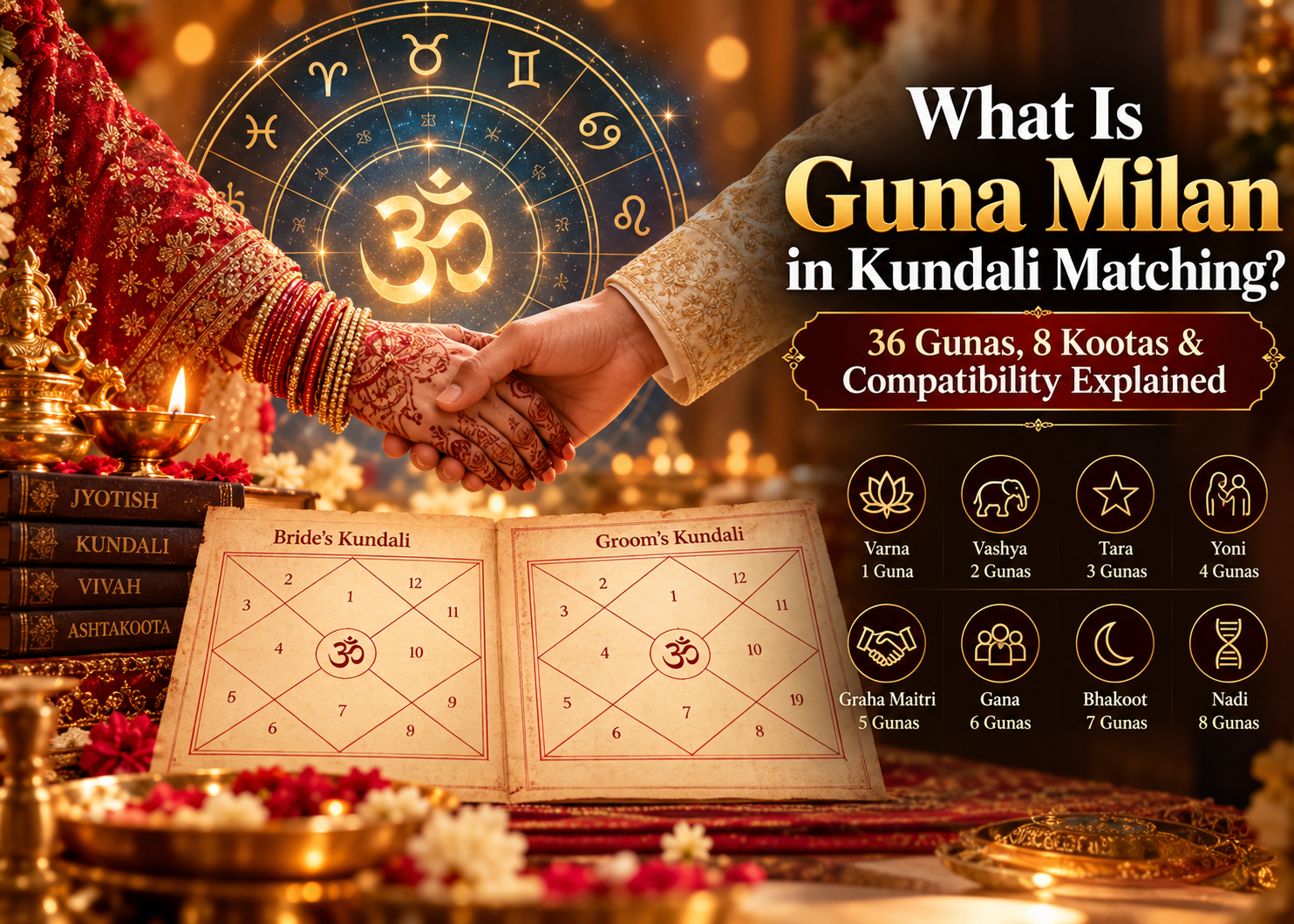

 Table of Contents
 Key takeaways







Leave a Comment