Introduction | Love Marriage or Arrange Marriage
Can your Kundli indicate what type of marriage is written in your future? Is it a love marriage or arrange marriage? In Vedic astrology, the answer begins with the relationship between the 5th house of romance, the 7th house of marriage, and the 2nd house of family.
The 5th house represents romantic involvement, the 7th represents marriage and partnership, and the 2nd represents family and continuity. When the ruling planets of these houses connect, their relationship helps explain how romance, marriage, and family participation may come together.
However, one planetary placement cannot establish your marriage path. The Ascendant determines the house lords, while their signs, placements, conjunctions, aspects, and planetary strength help explain the chart. The Navamsa (D9) chart and relevant planetary periods provide additional details.
Whether you are already in a relationship or considering a match introduced by your family, understanding these factors can help you explore the traditional astrological reading of your marriage prospects. For a more detailed reading, our marriage prediction by name and date of birth examines the relevant planetary positions and houses in your birth chart.
How Does Vedic Astrology Indicate Love Marriage or Arrange Marriage?
In Vedic astrology, the main question is whether the birth chart connects romantic involvement with marriage, places greater emphasis on family participation, or brings both themes together.
A love marriage reading mainly examines the connection between the 5th house of romance and the 7th house of marriage. An arrange marriage reading gives additional attention to the 2nd house of family and the 9th house of traditions, elders, and established values.
These are traditional ways of reading a Kundli, not fixed rules that determine a marriage type from one planetary placement.
For example, when the 5th house lord occupies the 7th house, romance and marriage become directly connected through the placement of the ruling planet. When the 7th house lord occupies the 2nd house, marriage connects with family matters. If both patterns occur in the same chart, the reading must consider both romantic involvement and family participation.
The full Kundli makes the picture clearer. The 5th house can show romantic interest without proving that a relationship will lead to marriage. Similarly, the 2nd house can show the importance of family without proving that parents will select the spouse.
The central question is how the houses of romance, marriage, and family connect in the birth chart. This is the starting point for love marriage or arrange marriage astrology.
A Quick Comparison About Love Marriage or Arrange Marriage:
|
Factor
|
Love marriage
|
Arrange marriage
|
|
Partner selection
|
Usually led by the individuals
|
Often involves family introductions
|
|
Relationship before marriage
|
Romantic connection generally develops first.
|
Emotional connection may develop after the introduction.
|
|
Family involvement
|
May begin later or vary by family
|
Often begins earlier
|
|
Compatibility assessment
|
May grow through the existing relationship
|
May involve structured discussions and family input
|
|
Common challenges
|
Family acceptance, expectations, or unresolved relationship issues
|
Limited familiarity, differing expectations, or pressure to decide
|
|
Potential advantage
|
Existing emotional connection
|
Broader family support and shared expectations
|
|
What supports a healthy marriage?
|
Respect, trust, communication, and shared goals
|
Respect, trust, communication, and shared goals
|
Neither path automatically produces a better marriage. The quality of the relationship depends on how the couple understands each other, handles disagreements, and makes decisions together.
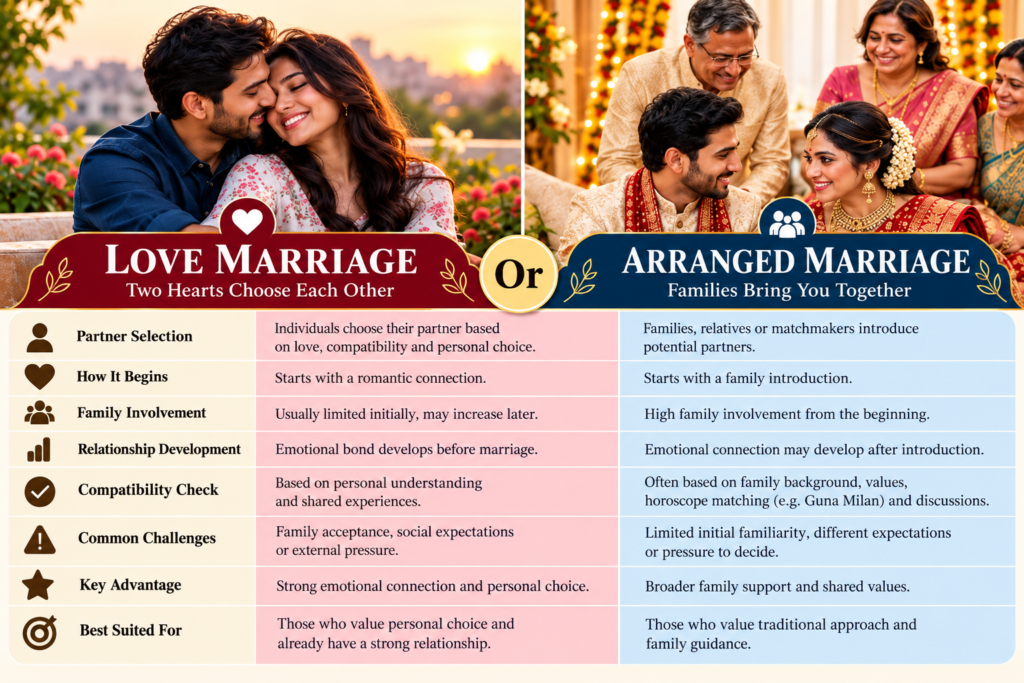
Love marriage begins with a romantic connection, while arrange marriage often starts with a family introduction. Both approaches can lead to a fulfilling marriage through mutual understanding, compatibility, and commitment.
Which Houses in a Kundli Are Examined for Marriage Prediction?
The 5th, 7th, and 2nd houses provide the main basis for examining romance, marriage, and family involvement. The 9th and 11th houses add details about traditions, social connections, and the fulfilment of aspirations.
1. The 5th House: Romance and the Choice of Partner
The 5th house represents romance, attraction, courtship, and emotional involvement. Its ruling planet is called the 5th house lord.
The 5th house becomes particularly relevant to love marriage when its lord connects with the 7th house or the 7th house lord. This connection brings romance and marriage together in the Kundli.
Consider three common combinations:
- The 5th lord in the 7th house: The lord of romance occupies the house of marriage. This directly connects romantic involvement with partnership in the chart’s traditional reading.
- The 7th lord in the 5th house: The lord of marriage occupies the house of romance. This connects partnership with courtship and emotional attraction.
- The 5th and 7th lords in conjunction or mutual aspect: The ruling planets of romance and marriage influence each other, creating a direct relationship between the two houses.
A sign exchange between these lords also connects their houses. Its importance depends on the signs involved, planetary strength, aspects, and the wider Kundli.
These combinations are considered possible signs of love marriage, not guarantees. The condition of both house lords and the other marriage-related factors must also be examined.
2. The 7th House: Marriage and the Life Partner
The 7th house represents marriage, the spouse, and committed partnership. Its ruling planet is the 7th house lord, whose placement and condition are central to marriage analysis.
The 7th lord connects marriage with other areas of life. Its placement in the 5th house links marriage with romance, while its placement in the 2nd house connects marriage with family and family continuity.
Its relationship with the 9th house can bring traditional values, beliefs, and guidance from elders into the reading.
The 7th house itself must also be examined. Its sign, occupants, aspects, and relationship with its ruling planet contribute to the overall reading. The Navamsa chart, also called the D9 chart, adds another layer of detail about marriage and partnership.
A strong connection between the 5th and 7th lords may support a love-marriage reading. A connection between the 7th and 2nd lords may bring greater emphasis to family involvement. When both relationships appear, the Kundli should be read as a whole rather than forced into one category.
3. The 2nd House: Family Involvement and Acceptance
The 2nd house represents family, family values, resources, and continuity. In marriage analysis, it helps show the connection between marriage and the formation or continuation of a family.
The most relevant relationship is between the 2nd house lord and the 7th house lord.
When the 7th lord occupies the 2nd house, or the two lords form a meaningful conjunction, aspect, or sign exchange, marriage and family matters become directly connected in the chart.
The 5th house provides an additional detail. If the 5th and 7th lords connect while the 2nd house lord also links with the marriage factors, the Kundli may support a reading in which romantic choice and family participation both feature in the marriage journey.
This is relevant to a love-cum-arrange marriage, in which a couple chooses each other and later involves their families.
However, the 2nd house does not independently establish parental approval or determine who selects the spouse. It shows family-related themes that must be read alongside the other marriage factors.
4. The 9th House: Traditions, Elders, and Family Values
The 9th house represents beliefs, dharma, higher principles, guidance, and traditions. Its role in marriage analysis becomes relevant when the 9th house lord connects with the 7th house or its lord.
For example, the 7th lord in the 9th house connects marriage with the themes represented by the 9th house. A relationship between the 9th and 7th house lords can also bring these themes together.
Such placements may be examined when considering the influence of family traditions, established values, or guidance from elders on marriage decisions.
However, the 9th house does not automatically indicate an arrange marriage. It can also be relevant to a love marriage that receives family approval or follows the couple’s shared values.
The reading depends on the house lords, their planetary strength, and their connections with the 5th and 2nd houses.
5. The 11th House: Fulfilment of Relationship Aspirations
The 11th house represents gains, social networks, aspirations, and the fulfilment of desires. In marriage analysis, it can add details about how relationship aspirations connect with marriage-related factors.
For example, a connection between the 11th house lord and the 5th or 7th house lord may be considered when examining whether romantic aspirations and marriage prospects are linked in the Kundli.
The 11th house can also provide details about friendships and social connections through which a person may encounter a potential partner, depending on the complete planetary combination.
However, it does not independently establish that a relationship will lead to marriage. The 5th and 7th houses remain central to the traditional reading of romance and partnership.
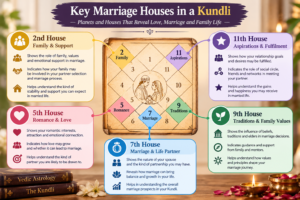
Understand how the 2nd, 5th, 7th, 9th, and 11th houses in Vedic astrology relate to family support, romantic relationships, marriage, traditions, and relationship aspirations.
Which Planetary Combinations May Indicate Love Marriage?
Once the relevant houses and their lords are identified, planetary relationships help refine the reading. Venus, Rahu, the Moon, and Mars contribute different themes, but their effects depend on their placements and connections with the marriage houses.
Connection Between the 5th and 7th House Lords
The relationship between the 5th and 7th house lords is a primary factor in traditional love marriage prediction.
A conjunction places the two ruling planets together. A mutual aspect allows them to influence each other, while a sign exchange links the houses through their respective rulers.
When this relationship receives support from the wider Kundli, it may indicate that romantic involvement plays a role in the marriage journey.
The reading changes according to the condition of the planets. Their relationship, dignity, and associations with other planets must be assessed before deciding whether the combination supports a love-marriage reading.
A connection between the 5th and 7th lords is therefore a starting point, not a final answer.
Venus Connected With the 5th or 7th House
Venus represents attraction, affection, romantic preferences, and relationship themes in traditional Vedic astrology.
When Venus occupies the 5th house, it places the planet associated with attraction in the house of romance. When Venus occupies the 7th house, its placement directly connects these themes with marriage and partnership.
Venus can also affect the reading through its conjunctions, aspects, and relationship with the 5th or 7th house lord.
Its strength and condition matter. Venus in the 7th house does not automatically guarantee a love marriage or a successful relationship. Its house rulership, planetary associations, and the complete Kundli determine how the placement should be read.
Rahu and Unconventional Relationship Circumstances
Rahu is traditionally associated with unconventional choices, strong desires, and circumstances that depart from established expectations.
When Rahu influences the 5th house, 7th house, Venus, or the relevant house lords, it may add an unconventional element to the relationship reading.
For example, Rahu’s connection with the 7th house may prompt an examination of whether partnership circumstances differ from familiar social or family expectations. Its connection with the 5th and 7th houses may also be considered when assessing whether romance and marriage follow an unconventional path.
However, Rahu does not automatically indicate an inter-caste marriage, an inter-religion marriage, or family opposition. These outcomes cannot be established from Rahu’s placement alone.
The Moon and Emotional Attachment
The Moon represents emotional responses, comfort, and personal needs. Its connection with Venus may add details about affection and romantic inclination. When the Moon and Venus connect with the 5th or 7th house, their relationship contribute to the reading of emotional involvement in partnership.
However, emotional attachment and marital commitment are different matters. The 7th house and its lord must still be examined to understand the marriage-related factors.
Which Kundli Combinations Indicate Arrange Marriage?
An arrang-marriage reading places greater emphasis on the connection between marriage and family-related factors. The 2nd and 9th houses become particularly relevant, while the 7th house remains the foundation of marriage analysis.
Connection Between the 2nd and 7th House Lords
The 2nd house represents family, and the 7th house represents marriage. When their ruling planets connect, the chart links marriage with family-related matters.
For example, the 7th lord in the 2nd house connects marriage with family continuity. A conjunction or mutual aspect between the 2nd and 7th lords creates another relationship between these themes.
If the 9th house lord also connects with these factors, the reading includes traditions, elders, or established values.
These combinations support a reading in which family involvement plays a prominent role in partner selection. They do not prove that parents will choose the spouse, nor do they rule out a romantic relationship before marriage.
Jupiter’s Influence on the 7th House
Jupiter represents wisdom, guidance, values, and expansion in traditional astrology.
When Jupiter occupies or aspects the 7th house, or connects with the 7th house lord, it contributes to the reading of marriage and partnership.
If Jupiter also connects with the 2nd or 9th house, family values, traditions, or guidance become relevant themes in the Kundli.
However, Jupiter’s influence does not independently establish an arranged marriage. Its placement must be assessed alongside the 5th, 7th, 2nd, and 9th houses and their ruling planets.
Saturn and a Deliberate Approach to Marriage
Saturn represents responsibility, patience, discipline, and restraint. Its influence on the 7th house or its lord is examined when reading commitment, caution, or delays within a marriage-related context.
Saturn in the 7th house does not automatically indicate an arranged marriage, nor does it independently prove that marriage will be delayed.
Its role depends on the ascendant, house rulership, planetary strength, aspects, conjunctions, and supporting factors in the birth and Navamsa charts.
Most importantly, Saturn should not be used as a shortcut for deciding whether a marriage will be love-based or family-arranged. The answer depends on the connections among the relevant houses and their lords.
What Indicates a Love-Cum-Arranged Marriage in Astrology?
A love-cum-arranged marriage combines personal choice with family participation. The couple may develop a relationship first and then seek family acceptance before marrying. The 5th, 7th, and 2nd houses provide the main basis for examining this possibility.
The 5th house represents romance, the 7th represents marriage, and the 2nd represents family. When the lords of these houses connect, the Kundli bring romantic involvement, marriage, and family participation into the same reading.
For example, a relationship between the 5th and 7th house lords connects romance with marriage. If the 2nd house lord also links with these planets, family-related factors become part of the same combination.
The 9th house can provide further details if its lord connects with the marriage factors, particularly when examining the role of traditions or guidance from elders.
This combination
be read as consistent with a relationship that progresses towards marriage with family involvement. However, no single combination guarantees family approval or a specific marriage outcome.
How to Know Love Marriage or Arrange Marriage by Date of Birth
A detailed marriage analysis requires the date, exact time, and place of birth. These details establish the Ascendant, house positions, planetary placements, and divisional charts needed for a proper reading.
Step 1: Establish the Ascendant and House Lords
The Ascendant determines the arrangement of houses and their ruling planets. Without identifying the Ascendant, the 5th, 7th, and 2nd house lords cannot be determined accurately.
For example, the 5th house lord changes according to the Ascendant. The same planet may rule different houses in different charts, so its meaning cannot be determined from its name or sign alone.
Step 2: Examine the 5th and 7th House Connection
Identify the 5th house lord and the 7th house lord. Check whether they occupy each other’s houses, form a conjunction, mutually aspect each other, or exchange signs.
This establishes whether the chart contains a direct relationship between romance and marriage. The planets’ strength, other aspects, and house rulerships then determine how that relationship should be read.
Step 3: Assess the 2nd and 9th Houses
Identify the 2nd and 9th house lords and examine their connections with the 7th house and its lord.
The 2nd house contributes family-related themes, while the 9th contributes traditions, beliefs, and guidance. Their connections with the marriage factors help assess the role of family participation in the traditional reading.
Step 4: Examine Venus, Rahu, and Other Relevant Planets
Assess Venus’s relationship with the 5th and 7th houses, Rahu’s influence on marriage-related factors, and the Moon’s role in emotional expression.
Mars, Saturn, and Jupiter may also contribute to the reading through their house rulerships, placements, and aspects.
The purpose is not to count favourable and unfavourable planets. It is to determine how their relationships support, modify, or complicate the main house connections.
Step 5: Assess the Navamsa Chart
The Navamsa, or D9 chart, is an important divisional chart in traditional marriage analysis.
Examine the D9 Ascendant, the 7th house, its lord, Venus, and their relationships with other relevant planets. Compare these factors with the birth chart to assess whether the marriage-related themes remain consistent across both charts.
The D9 chart should not replace the birth chart. Its reading depends on the complete planetary combination and accurate birth details.
Step 6: Review Vimshottari Dasha
Vimshottari Dasha provides a traditional method for examining planetary periods and sub-periods.
When assessing marriage timing, consider periods associated with the 7th house lord, the 5th house lord, Venus, and other planets connected with the marriage factors. Their relevance depends on their roles in the birth chart and their overall condition.
A Dasha period does not independently guarantee a wedding or determine whether the marriage will be love-based or arranged. It provides timing details for the combinations already identified in the chart.
Together, these steps form a structured approach to love marriage or arrange marriage prediction by date of birth. They explain why a meaningful reading requires the complete birth chart rather than a single planetary placement. For a personalised assessment, explore our marriage prediction by name and date of birth service.
Love Marriage or Arrange Marriage Predictions
1. How can I know whether I will have a love marriage or arrange marriage through my Kundli?
To understand whether your marriage is likely to be love marriage or arrange marriage, an astrologer examines the 5th house of love, 7th house of marriage, and their ruling planets. Their connections with the 2nd, 4th and 11th houses, along with Dasha periods, help assess the possibility.
2. Can astrology predict whether I will have a love-cum-arranged marriage?
Yes, Vedic astrology can help identify combinations associated with love-cum-arranged marriage. A connection between the 5th and 7th houses may indicate a romantic relationship leading to marriage, while links with the 2nd, 4th or 9th houses can suggest family involvement and acceptance.
3. Which houses and planetary combinations indicate love marriage in Kundli?
The 5th house represents love and romance, while the 7th house represents marriage and partnerships. A connection between their ruling planets, or the placement of the 5th lord in the 7th house, may indicate love marriage. The 11th house also helps assess the fulfilment of relationship desires.
Arranged Marriage Yog in Kundli
4. Which planetary combinations indicate arranged marriage in astrology?
Arranged marriage possibilities are assessed through the 7th house and its connections with the 2nd, 4th and 9th houses. Strong family-related influences, supportive Jupiter and a well-placed 7th lord may indicate family involvement in selecting a life partner. The complete birth chart is essential for confirmation.
5. Does the 7th lord in the 2nd house indicate an arranged marriage?
The 7th lord in the 2nd house connects marriage with family, values and household responsibilities. This placement may indicate family involvement in marriage decisions. However, it does not automatically confirm an arranged marriage. The 5th house, planetary aspects and Navamsa chart must also be considered.
Love-Cum-Arranged Marriage
6. Which houses indicate love-cum-arranged marriage in a birth chart?
The 5th and 7th houses help identify romantic relationships that may lead to marriage, while the 2nd house represents family life. Connections involving the 4th and 9th houses can also indicate domestic support and family blessings. Their combined influence helps assess love-cum-arranged marriage possibilities.
Family Approval and Relationship Concerns
7. Can astrology predict whether my parents will approve of my love marriage?
Astrology can help assess the possibility of family acceptance by examining the 2nd house of family, 4th house of domestic harmony and 9th house of elders and blessings. Their connections with the 5th and 7th houses may reveal supportive or challenging influences regarding your relationship.
8. Can astrology predict when my love marriage will take place?
Marriage timing is assessed through the 7th house, its ruling planet, Venus and relevant Mahadasha and Antardasha periods. Transits of Jupiter and Saturn can also act as timing triggers. An astrologer studies these factors together to identify favourable marriage periods rather than promising an exact date.
9. Which Mahadasha and Antardasha periods are favourable for marriage?
Mahadasha and Antardasha periods of the 7th lord, Venus, 5th lord or planets connected with the 2nd and 11th houses may support marriage. However, favourable periods depend on planetary strength, house ownership, D1 and D9 placements, and the overall condition of the birth chart.
Current Relationship and Marriage Compatibility
10. Can my Kundli predict whether I will marry my current boyfriend or girlfriend?
Your Kundli can help assess whether your existing relationship has the potential to develop into marriage. An astrologer examines the 5th and 7th houses, their ruling planets, Dasha periods and Navamsa chart. Your partner’s birth chart can provide further insight into compatibility and marriage possibilities.
11. Can astrology indicate whether my family will oppose my love marriage?
The 2nd, 4th and 9th houses are examined to understand family relationships, domestic harmony and support from elders. Their connections with the 5th and 7th houses may indicate possible disagreements or acceptance. Saturn, Rahu and other planetary influences are also considered before drawing conclusions.
Kundli Matching and Compatibility
12. Is Kundli matching necessary for love marriage?
Kundli matching is useful for love marriages because emotional attraction alone does not reveal every aspect of marital compatibility. Ashtakoota Guna Milan, Mangal Dosha, Nadi, Bhakoot and the 7th house can help assess compatibility. Both partners’ individual charts should be examined before marriage.
13. How can I check marriage compatibility with my partner through Kundli?
Marriage compatibility can be assessed through both partners’ birth charts. An astrologer examines Ashtakoota Guna Milan, Moon signs, Nakshatras, Mangal Dosha, Nadi and Bhakoot. The 7th house, Venus, Jupiter and Navamsa chart provide additional insight into emotional understanding and long-term marital harmony.
Breakup, Reconciliation and Future Spouse
14. Can astrology predict whether my ex will come back and marry me?
Astrology can examine the possibility of reconciliation by studying the 5th and 7th houses, Venus, the Moon and current Dasha periods. These factors may indicate renewed communication or relationship developments. However, a chart cannot guarantee another person’s decision or confirm that an ex will return.
15. Can a broken relationship turn into marriage according to astrology?
A broken relationship may have the possibility of reconciliation if favourable planetary periods activate the 5th and 7th houses. Venus, the Moon and relevant Dasha periods are also examined. However, astrology cannot guarantee reunion, as both partners’ choices and circumstances influence the outcome.
16. Can astrology predict the appearance and personality of my future spouse?
Vedic astrology examines the 7th house, its ruling planet, Venus, Jupiter and the Navamsa chart to understand possible spouse characteristics. These factors may offer insights into personality, temperament and general physical features. However, they cannot provide an exact description or guarantee a person’s appearance.
17. Can my Kundli reveal where or how I will meet my future life partner?
The 7th house and its ruling planet, along with the 5th, 9th, 10th and 11th houses, can offer clues about how you may meet your future partner. Their connections may point towards education, workplace, social circles, travel or family introductions.
Marriage Delays, Doshas and Unconventional Relationships
18. Which planetary combinations indicate delays or obstacles in marriage?
Saturn’s influence on the 7th house, a weak 7th lord or challenging planetary combinations may indicate delays in marriage. Rahu, Ketu and Mars can also create relationship challenges in certain chart conditions. An astrologer must examine planetary strength, Dasha periods and Navamsa before identifying the reasons.
19. Can Mangal Dosha affect love marriage or arranged marriage?
Mangal Dosha is assessed through Mars’s placement in specific houses of the birth chart. It may indicate certain areas of adjustment or conflict in married life, but it does not automatically prevent love marriage or arrange marriage. Both partners’ charts should be examined before reaching a conclusion.
20. Can astrology predict inter-caste or inter-religion marriage?
Astrologers examine Rahu’s influence, the 5th and 7th houses, and their connections with other planets to assess unconventional marriage possibilities. Certain combinations may indicate relationships outside traditional family or community expectations. However, no single placement can confirm an inter-caste or inter-religion marriage.
21. Can love marriage be possible even if my Kundli indicates arranged marriage?
Yes, a Kundli should not be interpreted through a single planetary combination. Marriage possibilities depend on the complete birth chart, D1 and D9 placements, planetary periods and individual circumstances. A chart suggesting family involvement does not necessarily rule out a love marriage.
Can Your Kundli Indicate Family Opposition or an Unconventional Marriage?
Questions about family opposition or unconventional relationships require a separate reading from the basic question of marriage type.
Rahu’s connection with Venus or the 5th and 7th houses may be examined when exploring unconventional relationship circumstances. The 2nd house and its lord provide details about family, while the 9th house and its lord provide details about traditions and established values.
The 4th house represents home, domestic comfort, and emotional foundations. Its relationship with the marriage factors may provide additional details when considering domestic circumstances, but it cannot independently establish whether parents will approve of a relationship.
Similarly, the 6th, 8th, and 12th houses may become relevant when examining particular relationship challenges, conflict, disruption, or separation-related themes. Their meaning depends on the specific question and the wider Kundli; they should not be added to the reading merely to create a negative prediction.
No planetary placement proves that a family will oppose a marriage. The Kundli may suggest themes for consideration, but actual family responses depend on the people and circumstances involved.
If you are in a relationship, use these readings as a starting point for reflection rather than as a reason to assume that your marriage will face opposition. Open communication, mutual consent, and a clear understanding of your partner’s intentions remain essential.
For relationship-related guidance, explore our love life prediction service.
How Does Kundli Compatibility Fit Into Marriage Analysis?
Marriage prediction and Kundli compatibility answer different questions.
Marriage prediction examines the traditional signs associated with an individual’s marriage prospects, possible relationship patterns, and timing. Compatibility analysis compares the birth charts of two people to assess their relationship according to a chosen astrological method.
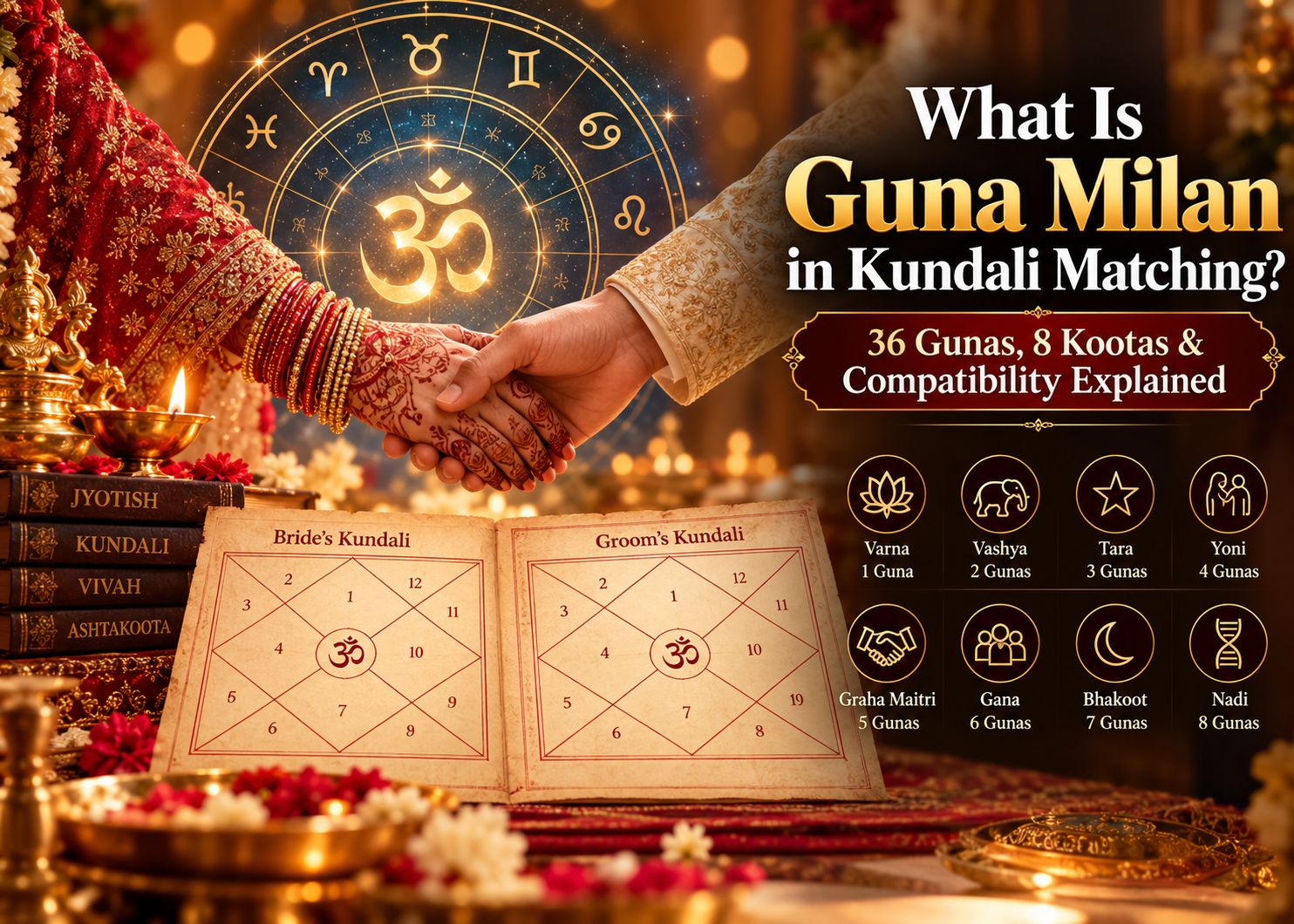
Guna Milan is one traditional method used in Hindu horoscope matching. It compares eight categories, commonly known as Ashtakoota, to assess compatibility under that system.
The result should not be treated as a complete judgement of the relationship. Broader chart factors, personal values, communication, consent, and practical compatibility also matter. If you are considering a potential match, read our guide to Guna Milan by date of birth.
You can also explore our Online Kundali Matching by Name and Date of Birth service for a detailed compatibility assessment. This approach is useful whether you are already in a relationship or considering a match introduced by your family. Understanding the possible marriage path and checking compatibility are related, but they require different questions and different parts of the Kundli.
Final Thoughts: Understand Your Marriage Prospects Through Your Kundli
The possibility of a love marriage or arrange marriage is examined through the relationships between romance, marriage, and family in the birth chart.
The 5th house and its lord establish the romantic factors. The 7th house and its lord form the foundation of marriage analysis. The 2nd house connects marriage with family, while the 9th house adds details about traditions and guidance. The 11th house may contribute information about aspirations and fulfilment.
Venus, Rahu, Jupiter, Saturn, the Navamsa chart, and Vimshottari Dasha help refine the reading when their roles are assessed within the complete Kundli. These factors belong to the traditional study of Indian astrology, but they should not be treated as a guarantee of a particular marriage type, wedding date, or family response.
Whether you are already in a relationship or considering a family-introduced match, understanding these connections can help you explore the traditional astrological reading of your marriage prospects. You can consult a famous Indian astrologer to discuss your Kundli and marriage-related questions. Consider astrological reading alongside your own choices, mutual consent, communication, and understanding of your future partner.
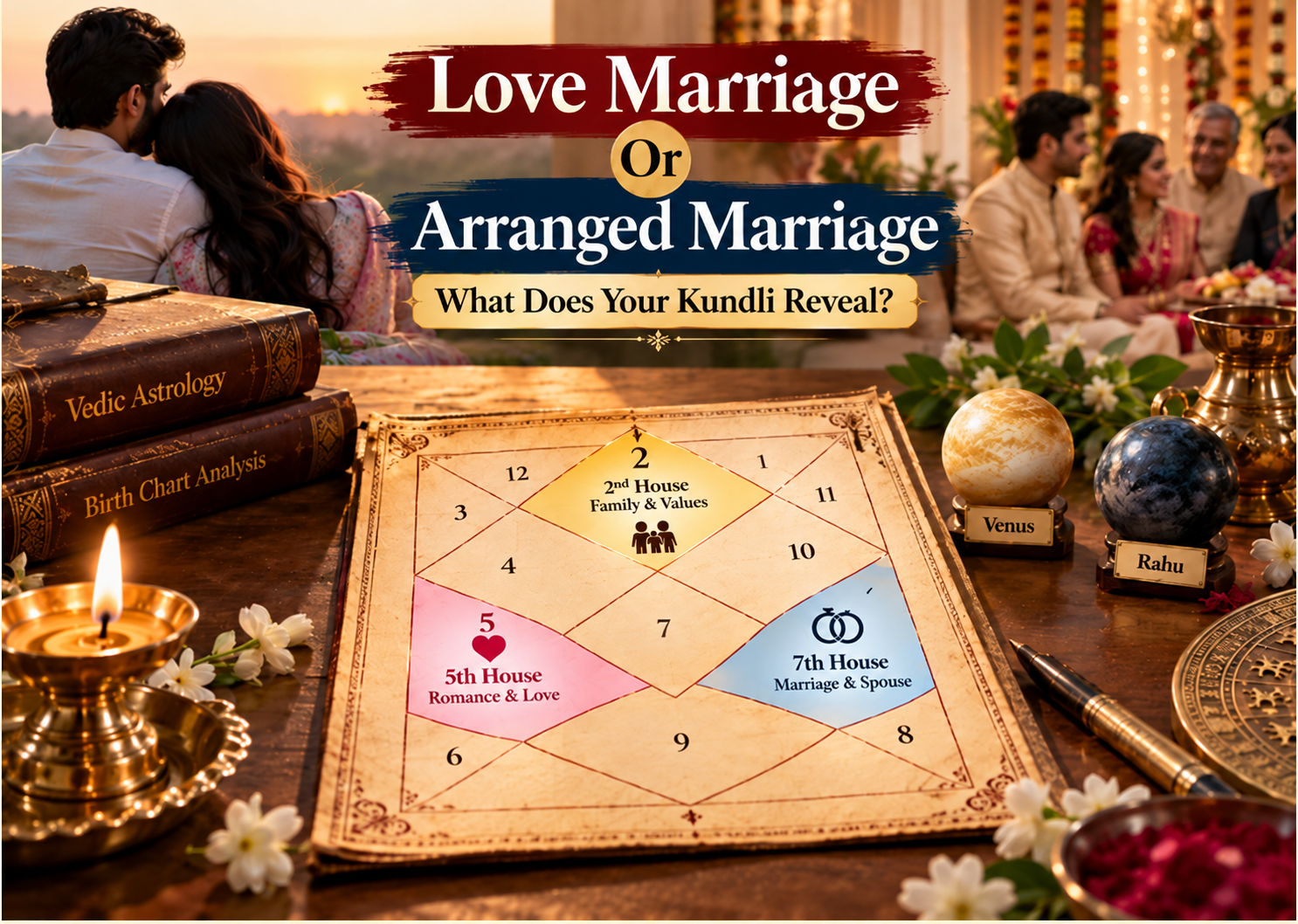
 Table of Contents
 Key takeaways





Leave a Comment