Introduction
A good salary and a respected position are where most people want to start. But real career success involves more than either. Discipline, professional responsibilities, long-term goals and the ability to remain focused also shape a person’s working life. In Vedic astrology, these aspects are closely associated with the 10th house in astrology, also known as Karma Bhava.
The tenth house represents the actions, responsibilities and professional contributions through which an individual builds a reputation, meaning how colleagues, clients and the wider public come to see their work and their word. It gives insights into career direction, working attitudes, leadership abilities, recognition and relationships with authority figures. It also helps explain how personal ambitions translate into practical achievements.
Career opportunities can’t be read from the 10th house alone. The house shows the field of work, the ruling planet shows the energy behind it, and aspects show what supports or blocks it. The Dashamsha (D10) chart looks at careers in more depth, and the running Mahadasha shows the period when these themes are most likely to play out. For a reading based on your own chart, see the career prediction by date of birth service.
Understanding this house also requires distinguishing professional development from academic achievement. While the tenth house connects knowledge with professional application, higher education involves several other astrological factors. These are traditional astrological interpretations, not scientific conclusions; OpenStax’s explanation of the distinction between astrology and astronomy explains the difference.
What Does the 10th House Represent in Astrology?
In Hindi, the 10th house is known as दशम भाव (Dasham Bhav), कर्म भाव (Karma Bhav) or कर्म स्थान (Karma Sthana) in Vedic astrology. The word Karma refers to actions, deeds and responsibilities, while Bhava means a house in the birth chart. Together, these terms describe the house associated with an individual’s actions, professional duties and contributions to society.
The tenth house holds significant importance because it represents how a person’s efforts turn into professional achievements, public recognition and social standing. It reflects career direction, working attitude, ambitions, authority and the responsibilities an individual undertakes throughout life. It also provides insights into relationships with employers, senior officials and people in positions of authority.
Jyotisha, the traditional Indian system of astrological knowledge, is recognised as one of the six Vedangas, or auxiliary disciplines of the Vedas. Its traditional role includes understanding planetary movements and determining appropriate timings for religious ceremonies and rituals. The Vedic Heritage Portal’s overview of Jyotisha provides historical context for its place within the Vedic tradition. Thus, the tenth house connects personal ambitions with actions, responsibilities and the recognition earned through one’s work.
The 10th house in astrology represents several important areas of life:
|
Area
|
Astrological Significance
|
|
Career and profession
|
The 10th house represents professional direction, occupation and responsibilities. It helps identify career-related tendencies, preferred working environments and the nature of professional duties.
|
|
Career goals
|
This house reflects ambition, achievements and long-term objectives. It indicates the desire to progress professionally, take on new challenges and establish a recognised position.
|
|
Discipline
|
The 10th House in Astrology represents commitment to duties, consistency and professional conduct. Saturn’s influence becomes particularly relevant when examining patience, perseverance and the ability to fulfil responsibilities.
|
|
Focus
|
The 10th house indicates the direction of effort towards professional priorities and responsibilities. Mercury and Saturn provide additional insight into analytical thinking, planning and sustained concentration.
|
|
Reputation
|
In the 10th house, reputation reflects public image, professional recognition and social standing. It shows how an individual’s actions, decisions and achievements influence the respect they receive.
|
|
Authority
|
The 10th house relates to leadership, management, decision-making and relationships with superiors. The Sun’s influence is particularly relevant when examining administrative abilities and positions of authority.
|
|
Government
|
This house represents government institutions, administration, public service and positions of authority. The Sun, Saturn and the sixth house provide additional insight into government-related professional opportunities.
|
|
Professional development
|
The 10th house reflects experience, promotions, increasing responsibilities and career advancement. The 11th house and D10 (Dashamsha) chart provide further insight into professional achievements and growth.
|
|
Working attitude
|
The 10th house represents an individual’s approach towards duties, commitments and performance. Planetary influences, particularly Saturn, Mars and Mercury, help explain work discipline, initiative and professional behaviour.
|
The tenth house therefore extends beyond employment. It represents how a person performs responsibilities and becomes recognised through their actions.
What Is the 10th House in Astrology in Hindi?
दशम भाव को कर्म भाव या कर्म स्थान भी कहा जाता है।
इस भाव से व्यक्ति के व्यवसाय और करियर की दिशा का पता चलता है। यह बताता है कि किस प्रकार के काम में रुचि होगी, कौन सा कार्य वातावरण अनुकूल रहेगा और नौकरी या व्यवसाय में कैसी जिम्मेदारियाँ मिल सकती हैं। करियर के लक्ष्य और महत्वाकांक्षा भी इसी भाव से जुड़े हैं। यह दिखाता है कि व्यक्ति आगे बढ़ने, नई चुनौतियाँ स्वीकार करने और समाज में अपनी अलग पहचान बनाने के लिए कितना उत्सुक है।
अनुशासन और एकाग्रता इस भाव के मुख्य पहलू हैं। अनुशासन का अर्थ है कर्तव्यों का पालन, नियमितता और कार्यस्थल पर अच्छा आचरण। इसमें शनि का प्रभाव विशेष रूप से देखा जाता है, क्योंकि धैर्य, दृढ़ता और जिम्मेदारी निभाने की क्षमता को शनि परखता है। एकाग्रता बताती है कि व्यक्ति अपना प्रयास किस ओर लगाता है। बुध और शनि मिलकर योजना बनाने, विश्लेषण करने और लंबे समय तक ध्यान टिकाए रखने की क्षमता के बारे में जानकारी देते हैं।
प्रतिष्ठा और सामाजिक सम्मान भी दशम भाव से जुड़े हैं। समाज में व्यक्ति की छवि, उसकी पेशेवर पहचान और उसे मिलने वाला आदर इस बात पर निर्भर करता है कि उसके कार्य और निर्णय दूसरों को कैसे दिखते हैं।
अधिकार और नेतृत्व का संबंध भी इसी भाव से है। प्रबंधन, निर्णय लेने की क्षमता और वरिष्ठ अधिकारियों के साथ संबंध इसमें देखे जाते हैं। प्रशासनिक योग्यता और सत्ता वाले पदों को समझने में सूर्य का प्रभाव महत्वपूर्ण माना जाता है। सरकारी सेवा और सार्वजनिक पदों की जानकारी के लिए सूर्य, शनि और षष्ठ भाव को भी देखा जाता है।
पदोन्नति, अनुभव और बढ़ती जिम्मेदारियों को समझने के लिए दशम भाव के साथ एकादश भाव और दशमांश कुंडली का अध्ययन किया जाता है। कार्य के प्रति दृष्टिकोण, यानी व्यक्ति अपने कर्तव्यों और प्रदर्शन को किस तरह लेता है, यह शनि, मंगल और बुध के प्रभाव से समझा जाता है।
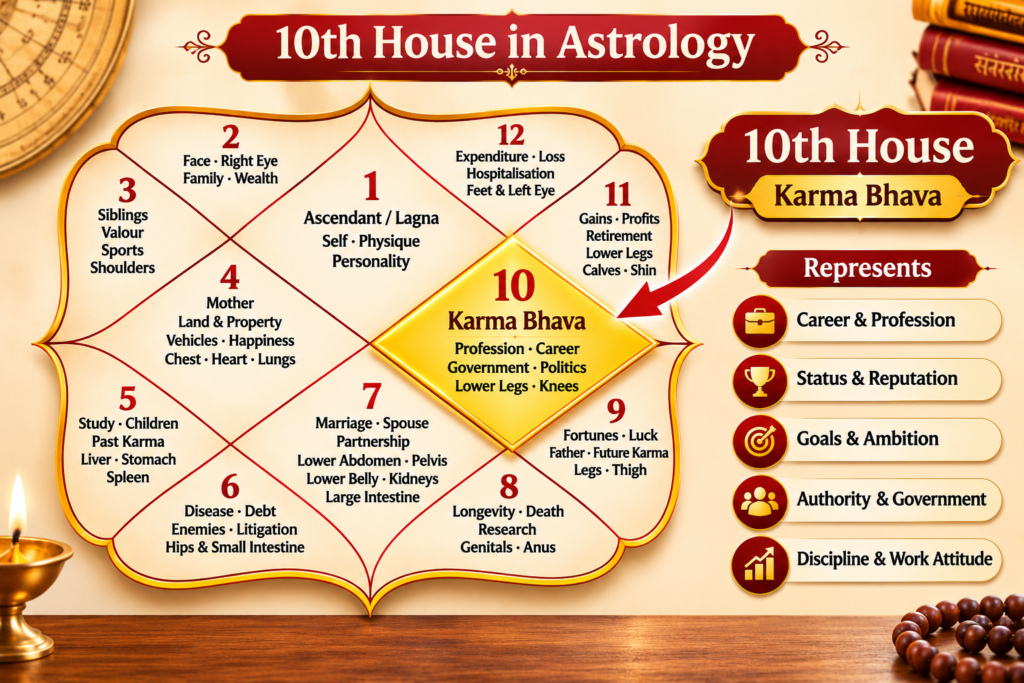
The 10th House in Vedic Astrology represents career, profession, social status, reputation, authority, ambition, and professional achievements.
Why Is the 10th House in Astrology Important for Career Goals & Professional Success?
The 10th house holds high importance when examining professional direction because it describes the nature of work, responsibilities and recognition associated with an individual. For example, someone may hold excellent academic qualifications but struggle to find satisfaction in their profession. Another person may develop professional recognition through practical experience rather than formal education.
The tenth house helps examine these different professional tendencies.
-
Career Direction and Professional Interests
The 10th house in astrology reflects an individual’s career direction, professional interests and the responsibilities they may fulfil throughout their working life.
Its zodiac sign (such as Aries, Taurus, Gemini, Cancer, etc.), ruling planet (10th house lord) and planetary occupants help indicate whether professional preferences lean towards leadership, independent work, communication, technical responsibilities, administration or advisory roles.
However, a single placement cannot indicate an exact profession. For example, a strong Mercury influencing the tenth house may support professions involving communication, analysis, commerce, writing or business. Its actual expression depends on the complete chart and the individual’s education and skills.
-
Career Goals and Ambition
The 10th house, also known as Karma Bhava, governs professional ambitions, career objectives and the desire to gain authority and recognition through one’s actions. Its strength, the placement of its lord and the influence of other planets show how a person pursues career goals and carries out responsibilities.
The Sun’s link with the 10th house can strengthen leadership qualities, administrative ability and the wish for recognition. When the Sun is strongly connected with this house, a person may feel drawn to roles where they can lead and be seen, such as politics, government service, administration, or running a team or organisation. The same pattern often suits senior management or heading a department, where decisions and public responsibility are part of the job.
Saturn’s influence points to a disciplined approach. Progress usually comes slowly, through patience, perseverance and sustained effort rather than quick wins. Saturn-linked careers often include government departments, engineering, construction, the judiciary, or any long-term field where steady work and reliability matter most.
The 10th lord’s relationship with the 9th and 11th houses also matters. The 9th house links career with fortune, guidance and opportunities, so a strong connection here can point toward teaching, law, counselling, higher education or advisory work. The 11th house represents professional gains, achievements and the fulfilment of ambitions, so a connection here often shows success through networks, partnerships or income from several sources.
These are tendencies, not fixed outcomes. The full chart and the running Mahadasha also shape how these themes play out.
-
Discipline and Working Attitude
The tenth house governs professional responsibilities, actions and the manner in which an individual fulfils their duties. Saturn holds particular significance in this regard, as it represents discipline, perseverance, patience and a sense of responsibility.
Its placement, dignity and association with the tenth house influence how consistently an individual works towards professional ambitions and handles demanding responsibilities.
A well-placed and favourably supported Saturn may indicate a disciplined approach to work, sustained effort and the ability to achieve professional objectives through perseverance. However, the sixth house, which governs service, daily duties and work-related routines, and the third house, which represents courage, initiative and self-effort, must also be examined.
Their relationship with the tenth house helps assess the ability to maintain professional discipline and fulfil responsibilities through consistent effort.
-
Professional Reputation and Recognition
The 10th house in astrology, known as Karma Bhava, governs professional reputation, public standing, authority and recognition earned through actions and responsibilities. Its planetary influences reveal how an individual establishes a professional identity and gains respect within society.
The Sun’s association with the tenth house can strengthen authority, leadership and recognition, while Jupiter’s influence may support respect through knowledge, wisdom, ethical conduct and guidance. The dignity and placement of the tenth house lord, along with its connection with the eleventh house, are also important.
These combinations help analyse professional achievements, fulfilment of ambitions, recognition from influential people and gains arising from actions.
How Does the 10th House in Astrology Influence Focus and Discipline?
Focus and discipline are essential for professional development, but Vedic astrology does not assign these qualities exclusively to one house.
The tenth house reflects a person’s effort towards career-related responsibilities. Saturn, Mercury, Mars and the Moon add different dimensions to this interpretation.
|
Planet
|
Influence on Focus and Discipline
|
|
Saturn
|
Patience, perseverance, routine and commitment to long-term goals
|
|
Mercury
|
Analytical thinking, planning, communication and mental organisation
|
|
Mars
|
Initiative, determination, execution and competitive drive
|
|
Moon
|
Emotional steadiness, mental engagement and adaptability
|
|
Sun
|
Clarity of purpose, confidence and leadership
|
|
Jupiter
|
Wisdom, judgement, broader goals and purposeful learning
|
For instance, a strong Saturn connection with the tenth house may indicate a preference for structured work and gradual professional development.
Mercury’s influence may support analytical responsibilities, while Mars can encourage decisive action. However, excessive Martian influence may also require attention to impatience.
The Moon becomes relevant when examining mental stability and the ability to remain engaged with responsibilities.
Therefore, an astrologer examines the tenth house alongside these planetary influences instead of assuming that one placement guarantees concentration or discipline.
Understanding the Lord of 10th House in Astrology
The lord of the 10th house in astrology is the planet that rules the zodiac sign occupying the tenth house from the Ascendant. It is also called the Dashamesha or Karmesha. Its placement, dignity, conjunctions and planetary aspects help explain how professional responsibilities may develop.
What Does the Placement of the 10th House Lord Indicate?
The placement of the tenth house lord connects professional matters with the themes of another house. The following examples explain some commonly examined combinations:
|
10th House Lord Placement
|
General Professional Indication
|
|
First House
|
Career closely connected with personal identity, leadership and independent responsibilities
|
|
Third House
|
Communication, writing, marketing, entrepreneurship and self-driven efforts
|
|
Sixth House
|
Employment, service, administration, competition and problem-solving
|
|
Seventh House
|
Business partnerships, client relationships, consulting and public dealings
|
|
Ninth House
|
Higher knowledge, teaching, advisory roles, law and philosophical pursuits
|
|
Tenth House
|
Strong emphasis on profession, responsibilities, leadership and public recognition
|
|
Eleventh House
|
Professional networks, organisational growth, gains and fulfilment of ambitions
|
|
Twelfth House
|
Foreign organisations, international work, research and institutional environments
|
These placements indicate possible connections rather than guaranteed outcomes.
For example, the tenth lord in the seventh house may connect professional responsibilities with partnerships and public interactions. However, the seventh lord, planets influencing the combination, and the D10 chart must also be examined before reaching a conclusion.
Similarly, the tenth lord in the ninth house can connect career development with advanced learning, teaching or advisory responsibilities.
Effects of Different Planets in the 10th House
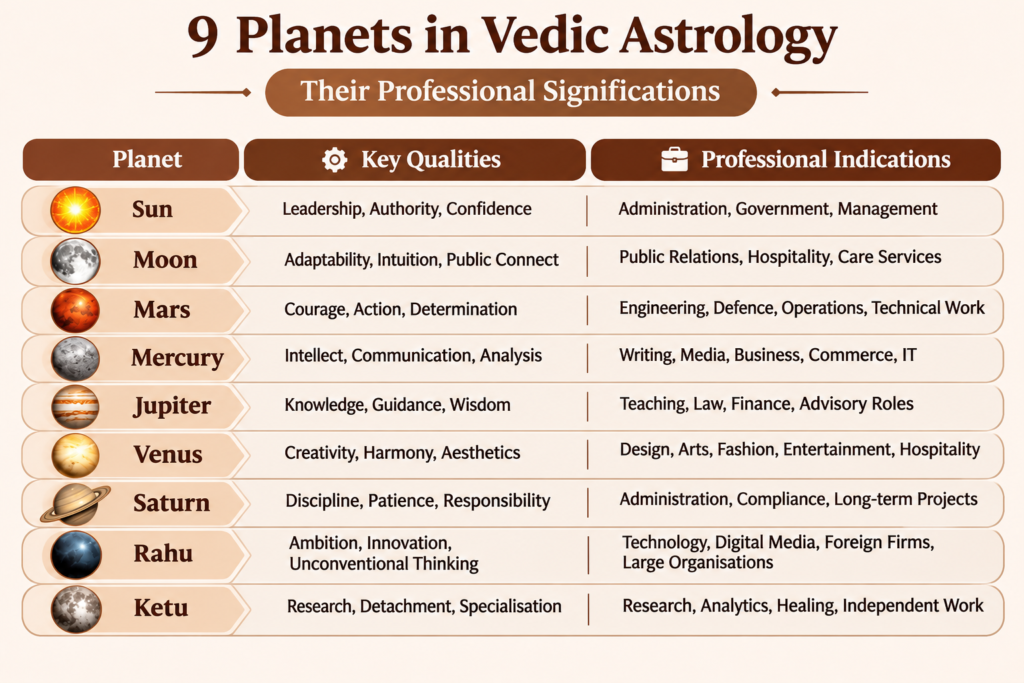
The nine planets in Vedic Astrology represent different qualities and influences associated with career choices, professional abilities, leadership, knowledge, creativity, and success.
Any of the nine planets (Navagrahas) occupying the tenth house, including the Sun, Moon, Mars, Mercury, Jupiter, Venus, Saturn, Rahu and Ketu, can influence professional responsibilities, career development and public reputation. Their results depend on their sign placement, planetary dignity, conjunctions, aspects and functional lordship, along with their relationship with the tenth house lord.
The following interpretations describe traditional tendencies rather than fixed career predictions.
|
Planet
|
Possible Professional Influence
|
|
Sun
|
Leadership, authority, administration, government and recognition
|
|
Moon
|
Public interaction, adaptability, hospitality and people-orientated responsibilities
|
|
Mars
|
Engineering, technical work, operations, defence and action-orientated professions
|
|
Mercury
|
Writing, commerce, communication, finance, analysis and business
|
|
Jupiter
|
Teaching, law, finance, guidance, management and advisory responsibilities
|
|
Venus
|
Design, fashion, entertainment, arts, hospitality and creative industries
|
|
Saturn
|
Administration, management, infrastructure, compliance and long-term responsibilities
|
|
Rahu
|
Technology, digital industries, foreign connections, unconventional professions and large organisations
|
|
Ketu
|
Research, specialised knowledge, independent work and analytical responsibilities
|
How Do These Planetary Placements Affect Professional Growth?
The Sun represents authority, confidence and leadership. Its placement in the tenth house can support administrative responsibilities and a desire for recognition. Its strength and relationship with the tenth lord determine how these qualities manifest.
The Moon connects professional life with public interaction, adaptability and emotional engagement. It may indicate professions involving people, care, hospitality or public communication. Its phases and planetary influences also matter when evaluating emotional steadiness.
Mars represents courage, initiative and action. It may support technical professions, engineering, operations and competitive environments. Its placement can encourage decisive performance, although impulsiveness may require attention.
-
Mercury in the 10th House:
Mercury governs intellect, communication, business and analytical abilities. Its influence may support careers involving writing, marketing, commerce, accounting, technology or information management.
-
Jupiter in the 10th House:
Jupiter represents knowledge, wisdom, teaching and guidance. Its influence may connect professional development with education, finance, law, management or advisory responsibilities.
Venus represents creativity, aesthetics, relationships and refinement. It may support professional interests connected with design, entertainment, fashion, hospitality and public relations.
-
Saturn in the 10th House:
Saturn represents responsibility, patience and sustained effort. It can support professional development through structured work, accountability and perseverance. Recognition may develop gradually rather than immediately.
Rahu is associated with ambition, unconventional approaches and expansion. Its influence may connect professional interests with technology, international organisations, media or emerging industries. The complete chart determines whether this ambition receives constructive direction.
Ketu represents detachment, specialised interests and unconventional approaches. Its placement may indicate independent working preferences, research-orientated interests or changing professional priorities. Its relationship with Rahu and the tenth lord becomes important.
Does the Zodiac Sign in the 10th House Affect Career Direction?
Yes. The zodiac sign occupying the 10th house in astrology provides additional information about professional temperament and the approach towards responsibilities.
For example, fire signs may suggest initiative, visibility and leadership, while earth signs may favour practical responsibilities and measurable results.
|
Zodiac Element
|
Professional Approach
|
|
Fire Signs (Aries, Leo, Sagittarius)
|
Initiative, leadership, enthusiasm and independent action
|
|
Earth Signs (Taurus, Virgo, Capricorn)
|
Practical thinking, stability, organisation and consistency
|
|
Air Signs (Gemini, Libra, Aquarius)
|
Communication, networking, analytical thinking and collaboration
|
|
Water Signs (Cancer, Scorpio, Pisces)
|
Intuition, adaptability, emotional understanding and creative expression
|
These are broad symbolic tendencies. The tenth lord and planets influencing the house provide the necessary context.
For example, Capricorn in the tenth house may emphasise structure, responsibility and gradual advancement because Saturn rules Capricorn. However, its actual results depend on Saturn’s placement and strength in the birth chart.
How Are Higher Studies Connected with the 10 th House in Astrology?
The 10th House in Astrology can provide insight into how education turns into professional responsibilities. However, it cannot independently determine higher education, academic interest or subject selection. For an education-related assessment, the fourth, fifth and ninth houses alongside Mercury and Jupiter are checked. Each house contributes a different aspect of academic development.
|
House or Planet
|
Educational Significance
|
|
Fourth House
|
Schooling, foundational education and learning environment
|
|
Fifth House
|
Intelligence, memory, learning ability and academic aptitude
|
|
Ninth House
|
Higher education, advanced knowledge, teachers and university studies
|
|
Second House
|
Speech, foundational knowledge and accumulated learning
|
|
Mercury
|
Reasoning, communication, analysis and intellectual abilities
|
|
Jupiter
|
Knowledge, wisdom, higher learning and guidance
|
|
D24 Chart
|
Additional assessment of education and academic development
|
|
Tenth House
|
Application of education in professional life
|
This distinction is important because academic qualifications and professional direction do not always follow the same path. For example, a person may develop an interest in advanced research through favourable educational indications, while the 10th house in astrology may show how that knowledge connects with a future profession.
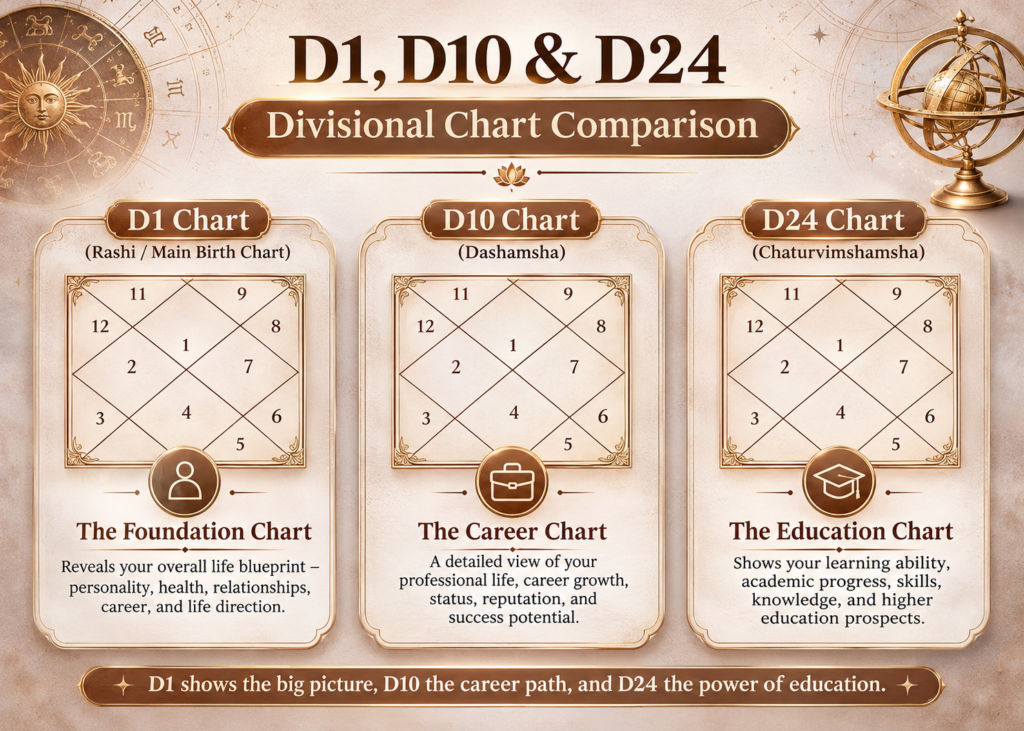
D1 reveals your overall life blueprint, D10 examines career and professional growth, while D24 provides insights into education, learning abilities, and academic development.
Role of the D24 and D10 Divisional Charts
Two divisional charts offer additional insight into education and professional development.
D24 (Chaturvimshamsha): The D24 chart is traditionally associated with education, learning and academic achievement. It helps examine the educational indications shown in the main birth chart, particularly through the fourth and fifth houses, Mercury and Jupiter.
D10 (Dashamsha): The D10 chart relates to profession, career responsibilities, professional standing and achievements. It helps refine the career indications observed in the main birth chart.
Both charts should be assessed alongside the D1 (Rashi) chart. They do not replace the main birth chart or independently establish academic or professional outcomes.
Can the 10th House in Astrology Reveal the Right Career After Higher Studies?
The tenth house can help examine how academic knowledge may connect with professional responsibilities.
For instance, a person pursuing postgraduate studies in finance may have professional indications associated with analytical work, management or advisory responsibilities.
Another person with a background in engineering may have chart combinations that connect career development with technical or operational fields.
The assessment involves examining the relationship between:
- The ninth house and its lord for higher education.
- The fifth house and Mercury for learning abilities.
- Jupiter for knowledge and guidance.
- The 10th house in astrology and its lord for professional direction.
- The D24 chart for additional educational indications.
- The D10 chart for professional development.
The running Mahadasha and Antardasha may also indicate periods when educational qualifications, professional training or career opportunities receive greater attention.
Which Other Houses Should Be Studied Alongside the 10th House?
A complete career assessment requires a broader understanding of professional and financial houses. The tenth house remains central, but other houses explain different dimensions of working life.
-
Sixth House – Job and Daily Responsibilities:
The sixth house represents service, employment, competition, daily routines and professional challenges. It helps examine the working environment, ability to manage responsibilities and relationships involving competition.
-
Seventh House – Business and Partnerships:
The seventh house represents partnerships, trade, contracts and public dealings. It becomes particularly relevant when examining independent business activities, consulting or partnership-based professions.
-
Second House – Income and Financial Stability:
The second house represents accumulated wealth, family resources and financial security. It helps examine the financial foundation supporting professional life.
-
Eleventh House – Gains and Professional Achievements:
The eleventh house represents gains, networks, professional associations and fulfilment of ambitions. Its relationship with the tenth house is particularly relevant when examining career growth and financial rewards.
-
Ninth House – Higher Knowledge and Fortune:
The ninth house connects professional development with advanced education, guidance, teachers and opportunities for personal growth.
These houses should be examined together with their ruling planets and relevant planetary periods.
How to Read Your 10th House in Kundali?
Understanding the tenth house in a Kundali requires more than identifying the zodiac sign occupying it.
The following steps explain the traditional approach:
- Identify the Ascendant: Find the Lagna in the birth chart because it establishes the starting point for house calculations.
- Locate the Tenth House: Count ten houses from the Ascendant to identify the 10th house in astrology and its zodiac sign.
- Identify the Lord of 10th House in Astrology: Determine which planet rules the sign occupying the tenth house.
- Examine Planetary Occupants: Study any planets placed in the tenth house, including their dignity and conjunctions.
- Assess Planetary Aspects: Examine influences from other planets on the tenth house and its lord.
- Check Related Houses: Evaluate the second, sixth, seventh, ninth and eleventh houses according to the career question.
- Study the D10 Chart: Examine the tenth house, its lord and the Ascendant in the Dashamsha chart.
- Consider Mahadasha and Antardasha: Determine whether the running planetary periods activate professional combinations.
- Review Relevant Transits: Examine planetary transits alongside the natal chart and running Dasha.
This method provides a more complete understanding than interpreting one planetary placement independently.
What If the 10th House in Astrology Is Empty or Its Lord Is Weak?
An empty tenth house does not mean that a person will struggle professionally or remain unemployed.
All twelve houses do not need planetary occupants to produce meaningful results. An unoccupied house continues to function through its ruling planet, planetary aspects and overall chart connections.
Similarly, a tenth lord placed in the sixth, eighth or twelfth house does not automatically indicate career failure.
Such placements require a more detailed assessment of planetary strength, functional lordship, conjunctions, aspects and divisional charts.
The sixth house may connect professional life with service, competition or problem-solving. The eighth can introduce research, transformation or sudden professional developments. The twelfth may connect work with foreign locations, institutions or behind-the-scenes responsibilities.
As the tenth is also an Upachaya house, its significations are traditionally associated with development through time and sustained effort.
Common Misconceptions About the 10th House in Astrology
Several misunderstandings can lead to incomplete interpretations of the 10th house in astrology.
Myth 1: An empty tenth house means no career
Reality: The tenth lord, planetary aspects, D10 chart and relevant Dashas remain important even when no planet occupies the house.
Myth 2: Saturn in the tenth house always delays professional success.
Reality: Saturn can represent patience, discipline and long-term effort. Its actual results depend on strength, dignity, lordship and planetary relationships.
Myth 3: The tenth house alone determines higher education.
Reality: Higher education requires an assessment of the fourth, fifth and ninth houses, Mercury, Jupiter and the D24 chart.
Myth 4: The tenth house reveals one fixed profession.
Reality: The tenth house indicates professional tendencies and responsibilities. Education, practical skills, personal interests and opportunities also influence career choices.
Myth 5: A strong tenth house guarantees wealth.
Reality: Professional recognition and financial gains are related but different matters. The second and eleventh houses also require examination.
Does the 10th House in Astrology Represent the Father or Other Relationships?
The tenth house primarily represents profession, authority, responsibilities and public reputation.
However, some traditional Vedic astrology interpretations also associate it with the father. The ninth house remains the primary house for examining the father in many widely followed Parashri interpretations.
The tenth house can additionally represent relationships with employers, senior officials, institutions and authority figures.
Therefore, the question of which relationship the 10th house represents requires contextual interpretation rather than assigning it exclusively to one family member.
Understand Your Career Path Through the 10th House in Astrology
The 10th house in astrology represents much more than professional status. It reflects actions, responsibilities, career ambitions, discipline, recognition and the contributions through which an individual develops a public identity.
Its ruling planet, planetary occupants, aspects and D10 chart help explain professional tendencies and possible career developments. At the same time, higher education requires an examination of the fourth, fifth and ninth houses, Mercury, Jupiter and the D24 chart.
No single house or planetary placement can provide a complete picture of professional life. A detailed interpretation must consider the entire birth chart, relevant planetary periods and important transits.
For those facing career uncertainty, considering a job change, planning a business or deciding how to use their educational qualifications, a personalised chart assessment can provide additional astrological perspective.
Explore Vedic astrology guidance from Astrologer Ammit Kapur to understand the planetary combinations influencing career direction, professional opportunities and long-term goals.

 Table of Contents
 Key takeaways










Leave a Comment