In bhakti, the divine name is a way of keeping Bhagwan in the heart (mann), especially when the mind is restless, fearful or distracted. But there is one thing we should understand before choosing a mantra. Not every Krishna mantra found online has the same scriptural status. Some are directly found in the Srimad Bhagavata Purana or Upanishadic texts. Some belong to established Vaishnava mantra traditions. Others are devotional prayers used by devotees for generations, but should not be falsely called Vedic mantras.
This guide brings these differences together in a simple way. You will find the Sanskrit text, easy pronunciation, meaning, source status, traditional importance and suitable use of ten powerful Krishna mantras and prayers. If you are a beginner, you will also understand which mantra may be suitable for your purpose, how to use a japa mala, whether 108 repetitions are really necessary, what to do when the pronunciation is not perfect, and how to follow a simple seven-day Krishna japa practice.
What Is a Krishna Mantra?
A powerful Krishna mantras is a sacred name, phrase or prayer used to remember and worship Lord Krishna through japa, dhyan and bhakti. Some krishna ji powerful mantras are directly preserved in Hindu scriptures, while others come from established devotional traditions. Their purpose may include naam-smarana, surrender, prayer, meditation and deepening one’s relationship with Bhagwan.
Mantra, naam and bhakti
In simple terms, a powerful Krishna mantra is a sacred sound or phrase used during spiritual practice. In Krishna bhakti, it can be a short mantra, a longer prayer, or even the repeated chanting of Krishna’s divine name. This is why naam-japa has an important place in Vaishnava traditions. A devotee does not only remember Krishna in the mind but also keeps His naam on the lips through regular chanting. Over time, this practice helps bring the mind closer to Krishna and keeps His remembrance present in daily life.
Krishna, Vasudeva, Hari and Govinda
You may notice that powerful krishna mantras use names such as Vasudeva, Hari, Govinda, Gopala and Damodara.
These are not unrelated deities being mixed together. They are names and forms through which Krishna is worshipped in different Vaishnava traditions.
For example, the opening verse of the Srimad Bhagavata Purana begins with Om Namo Bhagavate Vasudevaya, and its explanation identifies Vasudeva with Lord Sri Krishna.
Bija and longer prayers
Some mantras are very short and contain a bija, or seed syllable. Others are complete prayers made from several divine names.
A short mantra is not automatically more powerful than a longer one. What matters depends on the mantra, its tradition, the devotee’s bhav and the way it is practised.
Are These Mantras Scripturally Verified?
This is an important distinction because many websites call every Sanskrit Krishna prayer a Vedic mantra.
That is not accurate.
A Sanskrit mantra may come from a Purana, Upanishad, Tantra, Pancharatra text, stotra tradition or later devotional practice. These sources should not be treated as if they are all the same.
For this article, each mantra is therefore given a source status.
Mantras sourced from the Bhagavata Purana
One of the clearest examples is:
ॐ नमो भगवते वासुदेवाय नमः
The mantra appears at the beginning of the Srimad Bhagavatam 1.1.1. The text’s synonyms identify Vasudevaya as referring to Vasudeva, the son of Vasudeva, or Lord Sri Krishna.
Another important Krishna prayer appears in Srimad Bhagavatam 10.73.16:
कृष्णाय वासुदेवाय हरये परमात्मने ।
प्रणत-क्लेशनाशाय गोविन्दाय नमो नमः ॥
It praises Krishna as Vasudeva, Hari, Paramatma and Govinda, and describes Him as the remover of the distress of those who surrender to Him.
These are examples where we can give a specific scriptural reference instead of simply saying “ancient Vedic mantra.”
Mantras sourced from the Kali-Santarana Upanishad
The Hare Krishna Maha Mantra has a clear textual connection with the Kali-Santarana Upanishad.
The text presents sixteen names:
Hare Rama Hare Rama, Rama Rama Hare Hare
Hare Krishna Hare Krishna, Krishna Krishna Hare Hare
and describes these sixteen names as a means for countering the effects of Kali.
Some editions and Vaishnava traditions present the order as Hare Krishna first, which is the form most familiar today through Gaudiya Vaishnava and ISKCON practice. The important point is that the same sixteen names are involved.
Mantras from Gopala and Vaishnava mantra traditions
The Gopala-Tapani Upanishad is especially important for powerful Krishna mantras traditions. It preserves longer Gopala/Krishna mantra forms, including the well-known eighteen-syllable formula beginning:
क्लीं कृष्णाय गोविन्दाय गोपीजनवल्लभाय स्वाहा
Because mantra traditions have different rules and lineages, a specialised mantra should not be taken from a random internet list and treated casually.
Devotional compositions and later traditional mantras
Some popular formulas are devotional prayers rather than verses that we can confidently trace to one ancient scripture.
That does not make them meaningless.
A bhajan, naam-mantra or devotional invocation can have a very important place in bhakti. The point is simply to describe its origin honestly.
Scriptural source and devotional value are not the same question.
A mantra does not need to be falsely labelled “Vedic” to be worthy of devotion.
Quick Answer: Which Powerful Krishna Mantras Should You Chant?
Before choosing a mantra, ask yourself what you actually want from your sadhana.
If you are completely new, do not choose only because a website calls something the “most powerful.” Choose a mantra that you can chant regularly, understand and approach with shraddha.
|
Need or intention
|
Powerful Krishna mantras
|
Source status
|
Best time to chant
|
|
Daily Krishna remembrance
|
Om Namo Bhagavate Vasudevaya
|
Srimad Bhagavatam tradition
|
Morning or daily japa
|
|
Naam-smarana and bhakti
|
Hare Krishna Maha Mantra
|
Kali-Santarana Upanishad
|
Any time, especially japa or kirtan
|
|
Meditation and spiritual understanding
|
Krishna Gayatri
|
Traditional Krishna Gayatri
|
Morning practice
|
|
Surrender during difficulty
|
Krishnaya Vasudevaya…
|
Srimad Bhagavatam 10.73.16
|
Morning or evening prayer
|
|
Krishna bija-mantra practice
|
Klim Krishnaya Namah
|
Traditional mantra practice
|
Focused japa
|
|
Gopala bhakti
|
Klim Krishnaya Govindaya Gopijana Vallabhaya Svaha
|
Gopala-Tapani tradition
|
Guided mantra practice
|
|
Simple surrender
|
Shri Krishnah Sharanam Mama
|
Devotional Vaishnava tradition
|
Anytime
|
|
Damodara remembrance
|
Damodara Gayatri
|
Traditional Krishna Gayatri form
|
Morning or Kartika devotion
|
|
Radha-Krishna prema bhakti
|
Om Radhakrishnabhyam Namah
|
Devotional invocation
|
Bhajan and personal prayer
|
|
Protection and raksha
|
Krishna Kavacha
|
Krishna kavacha tradition
|
Puja and prayer
|
A note about “wealth” and “success”:
no Krishna mantra should be presented as a guaranteed money-making formula. In bhakti, prosperity may be prayed for, but mantra is not a replacement for karma, skill, effort, dharma and practical action.
10 Most Powerful Krishna Mantras (With Meaning & Benefits)
-
Om Namo Bhagavate Vasudevaya
Sanskrit
ॐ नमो भगवते वासुदेवाय ॥
Transliteration:
Om Namo Bhagavate Vasudevaya
Simple pronunciation:
Om Na-mo Bha-ga-va-te Vaa-su-de-vaa-ya
Word-by-word meaning
- Om: sacred syllable
- Namo/Namah: I bow, I offer obeisances
- Bhagavate: to Bhagavan, the Supreme Lord
- Vasudevaya: to Vasudeva, Krishna
Simple meaning:
“I offer my obeisances to Lord Vasudeva, Sri Krishna.”
Source status: Directly found in Srimad Bhagavatam 1.1.1. The opening of the Bhagavatam begins with this mantra, and its explanation identifies Vasudeva with Lord Krishna.
Core benefit
This is one of the best choices for steady daily Krishna remembrance and surrender. It is simple enough for beginners and deep enough to remain a lifelong japa mantra.
Best time or situation
Chant it in the morning, during puja, before starting an important task, or whenever you want to bring the mind back to Krishna.
Sanskrit
हरे कृष्ण हरे कृष्ण
कृष्ण कृष्ण हरे हरे ।
हरे राम हरे राम
राम राम हरे हरे ॥
Transliteration:
Hare Krishna Hare Krishna, Krishna Krishna Hare Hare,
Hare Rama Hare Rama, Rama Rama Hare Hare.
Simple pronunciation:
Ha-ray Krish-na, Ha-ray Krish-na, Krish-na Krish-na, Ha-ray Ha-ray.
Ha-ray Raa-ma, Ha-ray Raa-ma, Raa-ma Raa-ma, Ha-ray Ha-ray.
Simple meaning:
The mantra consists of the divine names Hare, Krishna and Rama. In Gaudiya Vaishnava understanding, it is approached as a prayer for engagement in divine service and remembrance.
Simple devotional meaning:
“O Krishna, O divine energy of the Lord, please keep me engaged in Your loving service.”
Source status: Directly connected with the Kali-Santarana Upanishad. The text identifies the sixteen names as the special means for overcoming the effects of Kali.
Core benefit
Its central practice is naam-smarana, remembrance of Bhagwan through His names. In Gaudiya bhakti, it is especially associated with developing devotion and prema.
Best time or situation
There is no need to wait for a special hour. Chant it during morning japa, evening kirtan, walking, household work or whenever you want to remember Krishna.
Sanskrit
ॐ देवकीनन्दनाय विद्महे
वासुदेवाय धीमहि ।
तन्नः कृष्णः प्रचोदयात् ॥
Transliteration:
Om Devakinandanaya Vidmahe
Vasudevaya Dhimahi
Tanno Krishnah Prachodayat.
Simple pronunciation:
Om De-va-kee-nan-da-naa-ya Vid-ma-he
Vaa-su-de-vaa-ya Dhee-ma-hi
Tan-no Krish-nah Pra-cho-da-yaat.
Word-by-word meaning
- Devakinandanaya: to the son of Devaki
- Vidmahe: may we know
- Vasudevaya: Vasudeva
- Dhimahi: we meditate upon
- Tanno: may that
- Krishnah: Krishna
- Prachodayat: inspire or guide us
Simple meaning:
“We meditate upon Krishna, the son of Devaki and Vasudeva. May He guide and inspire us.”
Source status: Traditional Krishna Gayatri form. The exact wording should not be casually presented as a verse from the Rigveda or the principal Vedic Gayatri. Different Krishna Gayatri forms are found in devotional and mantra traditions.
Core benefit
Traditionally used for dhyan, spiritual understanding, concentration and remembrance of Krishna.
Best time or situation
Morning is traditionally suitable for Gayatri practice. If you have received a specific Gayatri mantra from your guru or sampradaya, follow that instruction rather than mixing different practices.
-
Krishnaya Vasudevaya Haraye Paramatmane
Sanskrit
कृष्णाय वासुदेवाय हरये परमात्मने ।
प्रणत-क्लेशनाशाय गोविन्दाय नमो नमः ॥
Transliteration:
Krishnaya Vasudevaya Haraye Paramatmane
Pranata-Klesha-Nashaya Govindaya Namo Namah.
Simple pronunciation:
Krish-naa-ya Vaa-su-de-vaa-ya Ha-ra-ye Pa-ra-maat-ma-ne
Pra-na-ta Klesha Naa-shaa-ya Go-vin-da-ya Na-mo Na-mah.
Word-by-word meaning
- Krishnaya: to Krishna
- Vasudevaya: to the son of Vasudeva
- Haraye: to Hari
- Paramatmane: to the Supreme Self
- Pranata: those who surrender
- Klesha: distress or suffering
- Nashaya: remover
- Govindaya: to Govinda
- Namo Namah: repeated obeisances
Simple meaning:
“Again and again I offer obeisances to Krishna, Hari, the Supreme Self and Govinda, who removes the distress of those who surrender to Him.”
Source status: Srimad Bhagavatam 10.73.16. The verse directly identifies Krishna with Vasudeva, Hari, Paramatma and Govinda.
Important note:
This full verse is sometimes incorrectly called the Krishna Ashtakshara Mantra online. It is not an eight-syllable mantra. It is a longer prayer from Srimad Bhagavatam 10.73.16.
Core benefit
This is especially beautiful for sharanagati, or surrender. When the heart feels burdened, the prayer reminds us that Krishna is the refuge of the surrendered devotee.
Best time or situation
Chant it during morning or evening prayer, especially when you are going through fear, uncertainty or emotional difficulty.
Sanskrit
क्लीं कृष्णाय नमः ॥
Transliteration:
Klim Krishnaya Namah
Simple pronunciation:
Kleem Krish-naa-ya Na-mah.
Word-by-word meaning
- Klim: a bija syllable used in certain mantra traditions
- Krishnaya: to Krishna
- Namah: salutations, surrender
Simple meaning:
“I offer my obeisances to Krishna.”
Source status: Traditional Krishna bija-mantra practice. Related Krishna bija-mantras are preserved in the Gopala-Tapani mantra tradition.
Core benefit
The bija Klim is traditionally associated in certain mantra systems with attraction, desire and prema. In Krishna bhakti, it should not be reduced to a modern “manifestation spell” or a way to control another person’s feelings.
Its higher devotional use is remembrance of Krishna and divine prema.
Best time or situation
If you are new to bija-mantras, learn the practice from a qualified teacher or established sampradaya. Do not choose it simply because websites promise attraction or instant manifestation.
Sanskrit
क्लीं कृष्णाय गोविन्दाय
गोपीजनवल्लभाय स्वाहा ॥
Transliteration:
Klim Krishnaya Govindaya
Gopijana-Vallabhaya Svaha.
Simple pronunciation:
Kleem Krish-naa-ya Go-vin-daa-ya
Go-pee-ja-na Val-la-bhaa-ya Svaa-haa.
Word-by-word meaning
- Klim: sacred bija
- Krishnaya: to Krishna
- Govindaya: to Govinda
- Gopijana: the gopis
- Vallabhaya: beloved of
- Svaha: an offering or sacred concluding expression
Simple meaning:
“To Krishna, Govinda, the beloved of the gopis, my offering.”
Source status: Gopala-Tapani Upanishad mantra tradition.
The important point here is that the short internet formula “Om Shri Gopalaya Namah” and the longer Gopala mantra should not be presented as though they are the exact same textual mantra. The Gopala-Tapani tradition is associated with longer Krishna/Gopala mantra forms.
Core benefit
This mantra carries a strong Gopala bhav, remembering Krishna as Govinda and the beloved of the gopis. It is especially connected with loving Krishna bhakti rather than asking for a quick material result.
Best time or situation
Use it for personal Krishna sadhana if it belongs to your chosen tradition. Because it is a specialised mantra, guidance from a guru or knowledgeable practitioner is preferable.
-
Shri Krishnah Sharanam Mama
Sanskrit
श्रीकृष्णः शरणं मम ॥
Transliteration:
Shri Krishnah Sharanam Mama
Simple pronunciation:
Shree Krish-nah Sha-ra-nam Ma-ma.
Word-by-word meaning
- Shri Krishna: Lord Krishna
- Sharanam: refuge
- Mama: my
Simple meaning:
“Shri Krishna is my refuge.”
Source status: Established devotional Vaishnava surrender mantra. It is especially associated with the devotional tradition of surrender to Krishna.
Core benefit
Its strength is simplicity. When the mind is confused and you do not know what prayer to say, this mantra gives one clear bhav:
“Krishna, I take refuge in You.”
Best time or situation
Chant it before sleeping, during difficult moments, while travelling, or whenever you feel mentally overwhelmed.
Sanskrit
ॐ दामोदराय विद्महे
रुक्मिणीवल्लभाय धीमहि ।
तन्नः कृष्णः प्रचोदयात् ॥
Transliteration:
Om Damodaraya Vidmahe
Rukmini-Vallabhaya Dhimahi
Tanno Krishnah Prachodayat.
Simple pronunciation:
Om Daa-mo-da-raa-ya Vid-ma-he
Ruk-mi-nee Val-la-bhaa-ya Dhee-ma-hi
Tan-no Krish-nah Pra-cho-da-yaat.
Word-by-word meaning
- Damodaraya: to Damodara
- Vidmahe: may we know
- Rukmini-Vallabhaya: beloved of Rukmini
- Dhimahi: we meditate upon
- Tanno: may that
- Krishnah: Krishna
- Prachodayat: inspire or guide us
Simple meaning:
“We meditate upon Damodara, the beloved of Rukmini. May Krishna guide and inspire us.”
Source status: Traditional Krishna Gayatri form. It should not be presented as though this exact form is a direct quotation from the Vedic Gayatri tradition without a specific textual reference.
Core benefit
This mantra helps cultivate remembrance of Krishna through His loving forms as Damodara and Rukmini Vallabha.
Best time or situation
Morning meditation is suitable. It also has a natural place in Kartika month, when Damodara worship is especially important in many Vaishnava traditions.
-
Radha Krishna Yugal Mantra
Sanskrit
ॐ राधाकृष्णाभ्यां नमः ॥
Transliteration:
Om Radhakrishnabhyam Namah
Simple pronunciation:
Om Raa-dhaa Krish-naa-bhyaam Na-mah.
Word-by-word meaning
- Om: sacred syllable
- Radhakrishnabhyam: to Radha and Krishna together
- Namah: salutations
Simple meaning:
“I offer my salutations to Radha and Krishna together.”
Source status: Devotional Radha-Krishna invocation. This short form should not be presented as a direct Vedic quotation.
Core benefit
This is a simple mantra for Radha-Krishna remembrance and prema-bhakti. Its purpose is not to manipulate another person’s love. It is to turn the heart toward the divine relationship of Radha and Krishna.
Best time or situation
Use it during bhajan, evening prayer, personal dhyan or whenever you want to cultivate a loving Radha-Krishna bhav.
-
Krishna Kavacha for Protection
A kavacha is different from a short naam-mantra. The word means armour, and a kavacha is traditionally a longer protective prayer that invokes the Lord for raksha.
Simple Krishna invocation
ॐ श्रीकृष्णाय नमः ॥
Transliteration:
Om Shri Krishnaya Namah
Simple pronunciation:
Om Shree Krish-naa-ya Na-mah.
Meaning:
“I offer my salutations to Shri Krishna.”
Source status: Krishna kavacha tradition. Traditional Krishna kavacha texts are found in Vaishnava literature, including versions associated with the Brahma-Vaivarta Purana.
A kavacha should not be reduced to one sentence and presented as though that one line is the entire scripture. The complete kavacha is a longer protective prayer.
Core benefit
Traditionally, kavacha practice is associated with raksha, protection and courage. It can be especially meaningful when the devotee is facing fear, uncertainty or difficult circumstances.
Best time or situation
Use a complete Krishna kavacha during personal puja if it belongs to your tradition. For simple daily remembrance, Om Shri Krishnaya Namah is enough as a devotional invocation.
How to Chant Powerful Krishna Mantras Correctly (Step-by-Step)
Best time to chant: Brahma Muhurta or evening?
Brahma Muhurta, the period before sunrise, is traditionally considered a favourable time for japa. The surroundings are usually quiet and the mind has fewer distractions. But do not think:
“If I cannot wake up before sunrise, I cannot do Krishna japa.”
That is not practical. A sincere evening practice is better than a perfect morning routine that you never maintain. Choose a time you can follow every day.
How to use a Japa Mala
A traditional japa mala commonly has 108 beads, along with a larger meru or guru bead.
For each repetition:
- Hold the mala comfortably.
- Chant the mantra once.
- Move to the next bead.
- Continue until you complete your chosen count.
When you reach the meru bead, traditionally turn the mala around instead of crossing over it. The 108-count is traditional, but it is not a compulsory number for every beginner. You can begin with 11, 21 or another manageable number and slowly increase your practice. The goal is regular japa with attention, not racing to finish 108 repetitions.
Correct posture, space and mindset
- If you do not need an expensive puja room, choose a clean and reasonably quiet place.
- Sit comfortably. The floor is traditional, but a chair is also fine if that helps you sit steadily.
- Keep the spine naturally upright.
- Before beginning, take a few slow breaths.
- Then bring Krishna into your mind.
- You can silently pray:
- “Shri Krishna, please accept this japa and keep my mind at Your feet.”
This simple bhav can make the practice feel less mechanical.
Silent, soft or spoken chanting
There are different traditional forms of japa.
Vaikhari japa is spoken clearly enough to hear.
Upamshu japa is very soft, almost under the breath.
Manasik japa is mental repetition.
If you are a beginner, soft or audible chanting is often easier because you can hear the mantra and bring the mind back whenever it wanders.
Once concentration becomes steadier, mental japa can also be practised.
5 Common Mistakes Beginners Make
- Changing the mantra every day: – Give one mantra enough time. Constantly searching for a stronger mantra can itself become a distraction.
- Treating japa like a race: – Slow down. Hear the words. Let the mantra enter the mind.
- Thinking 108 is compulsory: – It is a traditional count, not a universal requirement.
- Becoming afraid of small pronunciation mistakes: – Learn correct pronunciation as much as possible, but do not become so nervous that you stop chanting.
- Treating mantra as a shortcut for worldly problems: – Prayer and practical effort should go together. Chant Krishna naam, but also do your work, fulfil your responsibilities and take the right practical steps.
What Happens When You Chant Krishna Mantras Daily?
-
Mental clarity and stress reduction
Japa gives the mind one repeated object of attention. Instead of following every thought, you return again and again to the same sacred name. Modern research on mantra-based meditation suggests possible benefits for stress, anxiety and psychological well-being, although studies vary in quality and the evidence does not prove that every mantra produces the same result.
So it is reasonable to say that regular chanting may support calmness and concentration. It is not reasonable to promise a specific medical result.
-
Emotional steadiness and inner peace
When the mind is disturbed, repeating Krishna’s name can create a small space between the emotion and the reaction. In bhakti, the practice goes further than simply calming the mind.
You are turning toward Bhagwan. That is why devotees often use naam-japa during grief, fear, loneliness or confusion. The mantra becomes a form of remembrance and surrender.
-
Spiritual growth and connection to bhakti
The deeper purpose of Krishna mantra is smarana, remembrance of Krishna. With regular practice, the devotee tries to carry that remembrance beyond the puja room. While working, eating, travelling, serving family or dealing with difficulty, Krishna remains somewhere in the heart.
This is the spirit of sadhana.
The aim is not only:
“I want to feel peaceful.”
It gradually becomes:
“I want to remember Krishna.”
That change in bhav is central to bhakti.
What does science actually prove?
Research can study attention, stress, breathing, repetitive sound and meditation. It cannot scientifically measure the full spiritual meaning of Krishna naam, bhakti or prema in the same way a devotee understands them.
So both sides should be kept clear.
- Tradition: Krishna naam is a spiritual practice of remembrance and devotion.
- Research: Repetitive meditation and mantra practices may support attention, relaxation and psychological well-being.
Neither statement needs to be exaggerated.
7-Day Powerful Krishna Mantras Practice Plan for Beginners
Day 1–2: Building the habit with the Moola Mantra
Start with:
ॐ नमो भगवते वासुदेवाय ॥
Chant it 11 or 21 times.
Sit quietly for another minute after finishing.
Do not worry about having a big spiritual experience.
Your only goal is:
Sit. Chant. Hear. Remember Krishna.
Day 3–4: Add the Maha Mantra
Continue your first mantra.
Then chant the Hare Krishna Maha Mantra for five to ten minutes.
Do not rush. Try to hear each word clearly.
If your mind wanders, gently bring it back.
That returning is itself part of the practice.
Day 5–7: Add surrender
Continue your chosen daily mantra.
Then spend a few minutes with:
श्रीकृष्णः शरणं मम ॥
Shri Krishnah Sharanam Mama
Think about the meaning:
“Shri Krishna is my refuge.”
If you already follow a guru or sampradaya, keep your established mantra practice above this general beginner plan.
Simple Krishna mantra chant sheet
For daily practice, keep these four together:
ॐ नमो भगवते वासुदेवाय ॥
Om Namo Bhagavate Vasudevaya
हरे कृष्ण हरे कृष्ण
कृष्ण कृष्ण हरे हरे ।
हरे राम हरे राम
राम राम हरे हरे ॥
श्रीकृष्णः शरणं मम ॥
Shri Krishnah Sharanam Mama
कृष्णाय वासुदेवाय हरये परमात्मने ।
प्रणत-क्लेशनाशाय गोविन्दाय नमो नमः ॥
You do not need to chant all four every day.
Choose one as your main japa and keep the others for different devotional moods.
Conclusion: Choosing the Right Powerful Krishna Mantras for Your Life
There is no need to collect ten mantras just because an article calls them powerful. For most devotees, one mantra practised regularly is better than ten mantras practised casually.
And if you are attracted to bija or specialised mantra practice, learn the tradition before beginning it. Most importantly, do not measure Krishna japa only by immediate results.
- Sit with shraddha.
- Chant with attention.
- Hear the name.
- Continue your dharma and seva.
Slowly, the practice can move from something you do for a few minutes each day to something the heart remembers naturally. That is the beauty of naam-smarana. The goal is not only to repeat Krishna’s name, but to carry that remembrance with you in everyday life.
Spiritual practices can bring a sense of peace and clarity, especially during times when life feels uncertain. For those who also seek guidance through astrology, understanding the planetary influences in a birth chart can offer another way to reflect on life’s different phases. You can explore personalised guidance from the leading astrologer in India to gain a deeper perspective on your journey.
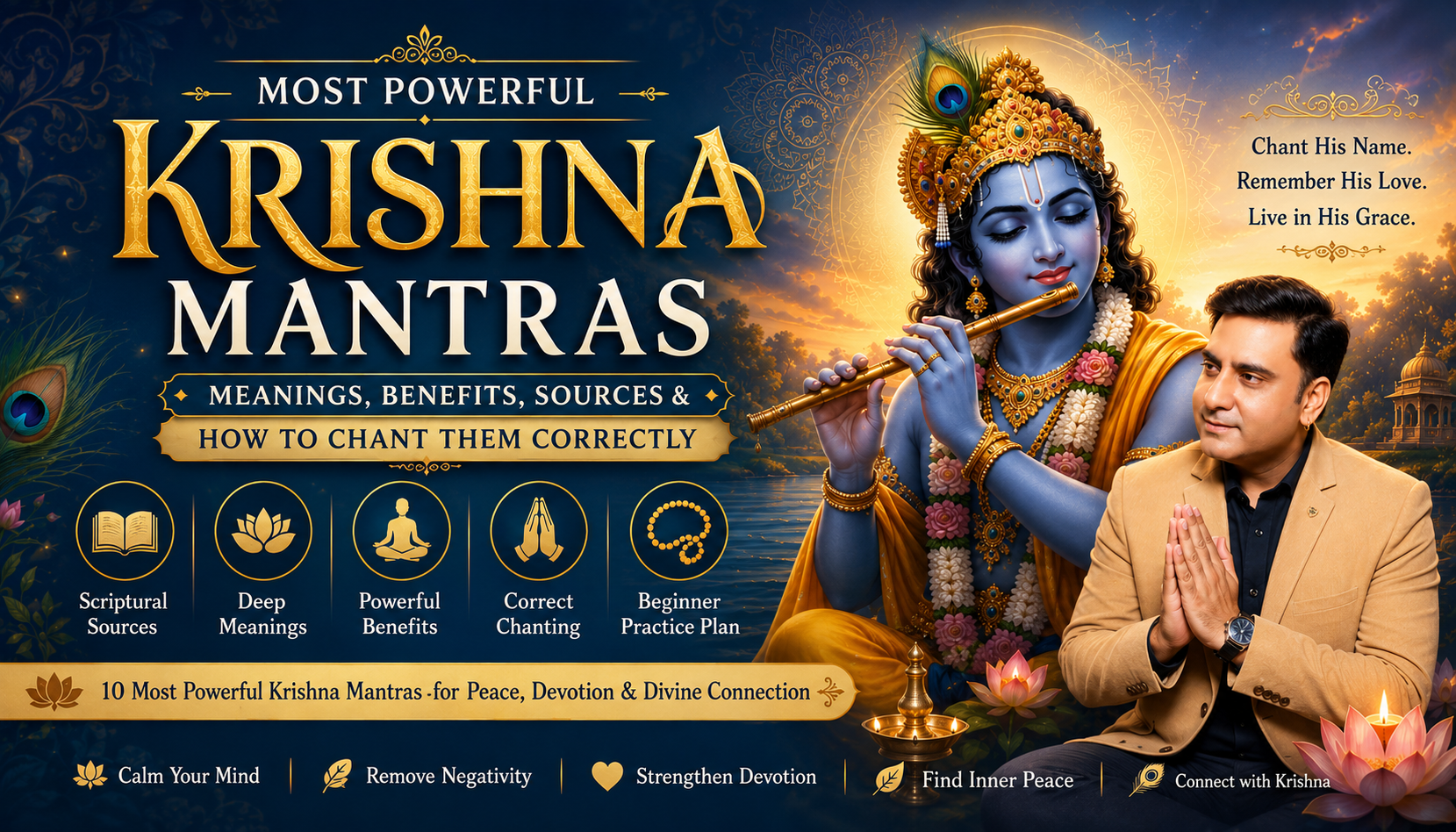

 Table of Contents
 Key takeaways





Leave a Comment